
Join Our JEE Preparation Group
Prep with like-minded aspirants; Get access to free daily tests and study material.
Sign in
Please select an account to continue using cracku.in
↓ →
Join Our JEE Preparation Group
Prep with like-minded aspirants; Get access to free daily tests and study material.
The structures of A and B formed in the following reaction are: Ph = -C$$_6$$H$$_5$$
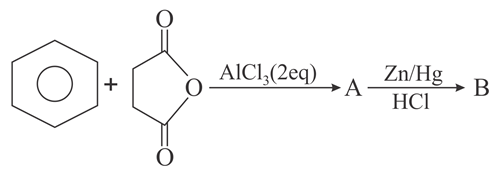
The reaction sequence begins with a Friedel-Crafts acylation. Succinic anhydride reacts with the Lewis acid catalyst, $AlCl_3$, causing the cyclic anhydride ring to open and generate an electrophilic acylium ion. This electrophile attacks the benzene ring, resulting in the formation of an aromatic ketone with a tethered carboxylic acid group. Therefore, compound A is 3-benzoylpropanoic acid, with the structure $Ph-C(=O)-CH_2-CH_2-COOH$. Two equivalents of $AlCl_3$ are required for this step because the second equivalent must complex with the newly formed carboxylic acid group to prevent it from deactivating the catalyst.
The second step utilizes zinc amalgam and concentrated hydrochloric acid ($Zn/Hg$, $HCl$), which are the standard reagents for a Clemmensen reduction. This reaction specifically targets the ketone carbonyl group, reducing it entirely to a methylene ($CH_2$) group while leaving the carboxylic acid functional group completely unaffected. Consequently, the carbonyl group adjacent to the phenyl ring in compound A is reduced. Therefore, compound B is 4-phenylbutanoic acid, with the structure $Ph-CH_2-CH_2-CH_2-COOH$.
These derived structures for compounds A and B exactly correspond to the first given choice.
Correct Option: A
Was this solution helpful?
Create a FREE account and get:
_1.webp)

Educational materials for JEE preparation

Ask our AI anything

AI can make mistakes. Please verify important information.
AI can make mistakes. Please verify important information.
