Join Our JEE Preparation Group
Prep with like-minded aspirants; Get access to free daily tests and study material.
Sign in
Please select an account to continue using cracku.in
↓ →
Join Our JEE Preparation Group
Prep with like-minded aspirants; Get access to free daily tests and study material.
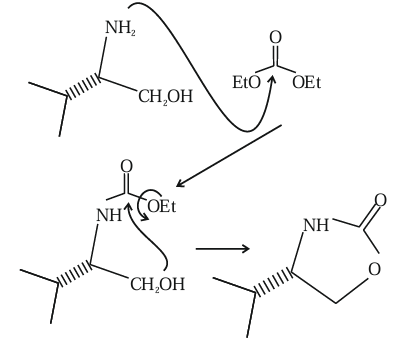
Step 1: Intermolecular Nucleophilic Acyl Substitution (Carbamate Formation)
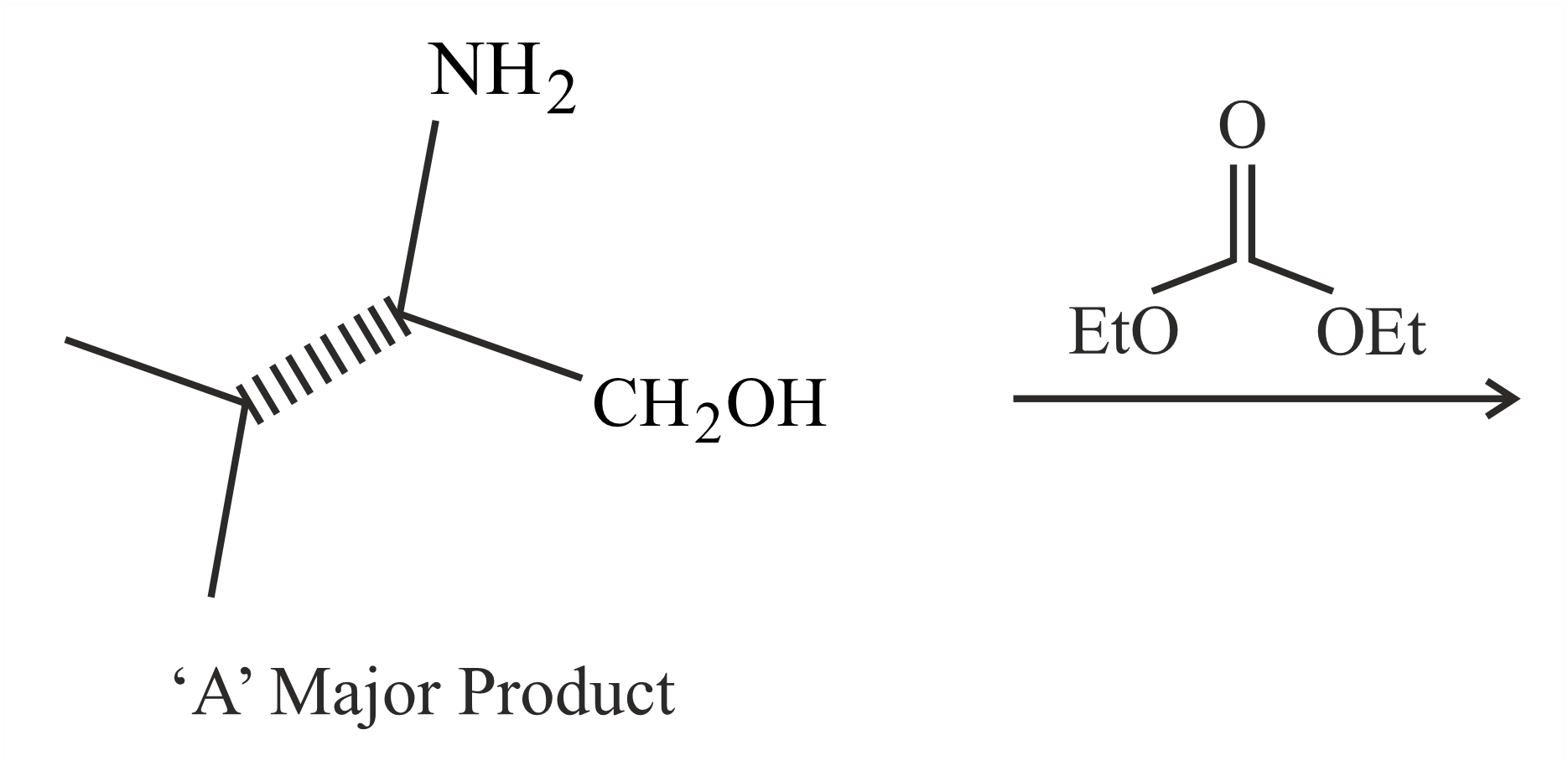
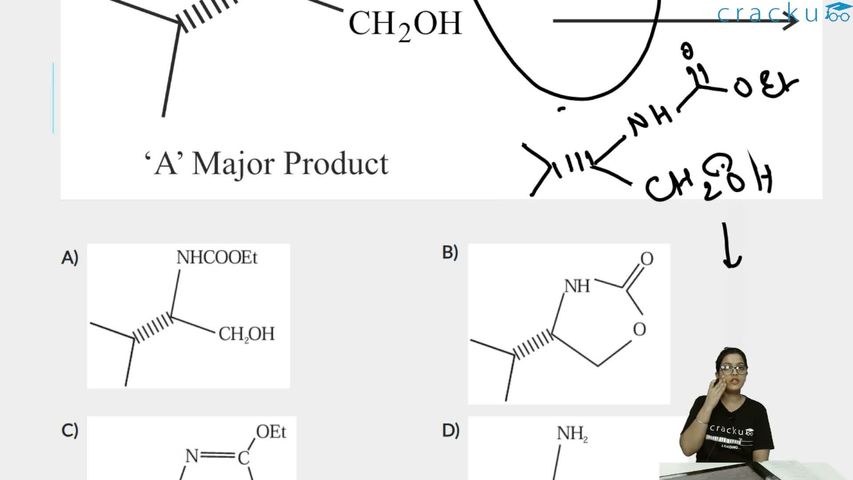
The primary amino group ($$\text{--NH}_2$$) of the starting material is a stronger nucleophile than the primary hydroxyl group ($$\text{--CH}_2\text{OH}$$). It attacks the carbonyl carbon of diethyl carbonate ($$\text{EtO--CO--OEt}$$), displacing one ethoxide ($$\text{--OEt}$$) leaving group to form an ethyl carbamate intermediate:
$$\text{R--NH}_2 + \text{EtO--CO--OEt} \rightarrow \text{R--NH--CO--OEt} + \text{EtOH}$$Step 2: Intramolecular Cyclization (Oxazolidin-2-one Ring Closure)
The adjacent hydroxyl group ($$\text{--CH}_2\text{OH}$$) now acts as an internal nucleophile. It attacks the carbonyl group of the newly formed carbamate line, displacing the second ethoxide group ($$\text{--OEt}$$) through an intramolecular nucleophilic acyl substitution:
$$\text{R--NH--CO--OEt} \xrightarrow{\text{Intramolecular}} \text{5-membered cyclic carbamate (oxazolidin-2-one)} + \text{EtOH}$$Stereochemistry Retention:
Crucially, throughout both nucleophilic substitution steps, neither bond connected to the chiral center is ever broken or altered. Because the chiral center remains completely undisturbed, its original configuration (wedge/dash orientation of the tert-butyl group) is fully retained in the final product.
Was this solution helpful?
Click on the Email ☝️ to Watch the Video Solution
Create a FREE account and get:
_1.webp)

Educational materials for JEE preparation

Ask our AI anything

AI can make mistakes. Please verify important information.
AI can make mistakes. Please verify important information.