Join Our JEE Preparation Group
Prep with like-minded aspirants; Get access to free daily tests and study material.
Sign in
Please select an account to continue using cracku.in
↓ →
Join Our JEE Preparation Group
Prep with like-minded aspirants; Get access to free daily tests and study material.
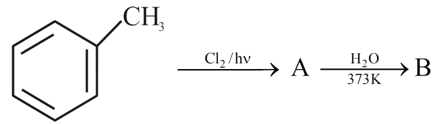
In side-chain chlorination of toluene using $$Cl_2/h\nu$$, chlorine substitutes the benzylic hydrogen atoms to form $$Ph-CH_2Cl$$, $$Ph-CHCl_2$$, or $$Ph-CCl_3$$ depending on the extent of chlorination. Subsequent hydrolysis replaces chlorine atoms with hydroxyl groups.
Option A is incorrect because $$Ph-COCl$$ cannot be formed in the first step. The reagents $$Cl_2/h\nu$$ only cause free-radical chlorination and do not introduce an oxygen atom or generate a carbonyl group.
Option C is incorrect because hydrolysis of $$Ph-CH_2Cl$$ produces $$Ph-CH_2OH$$ (benzyl alcohol). Formation of $$Ph-CHO$$ (benzaldehyde) is not possible from an intermediate containing only one chlorine atom.
Option D is incorrect because hydrolysis of $$Ph-CHCl_2$$ first forms the unstable gem-diol $$Ph-CH(OH)_2$$, which loses water to give $$Ph-CHO$$ (benzaldehyde). Formation of $$Ph-COOH$$ (benzoic acid) requires the intermediate $$Ph-CCl_3$$, not $$Ph-CHCl_2$$.
Option B is correct because $$Ph-CHCl_2$$ (benzal chloride) on hydrolysis forms the unstable gem-diol $$Ph-CH(OH)_2$$, which dehydrates to yield $$Ph-CHO$$ (benzaldehyde).
Therefore, the correct sequence is:
$$Ph-CHCl_2 \rightarrow Ph-CHO$$
Hence, Option B is the correct answer.
Was this solution helpful?
Create a FREE account and get:
_1.webp)

Educational materials for JEE preparation

Ask our AI anything

AI can make mistakes. Please verify important information.
AI can make mistakes. Please verify important information.