
Join Our JEE Preparation Group
Prep with like-minded aspirants; Get access to free daily tests and study material.
Sign in
Please select an account to continue using cracku.in
↓ →
Join Our JEE Preparation Group
Prep with like-minded aspirants; Get access to free daily tests and study material.
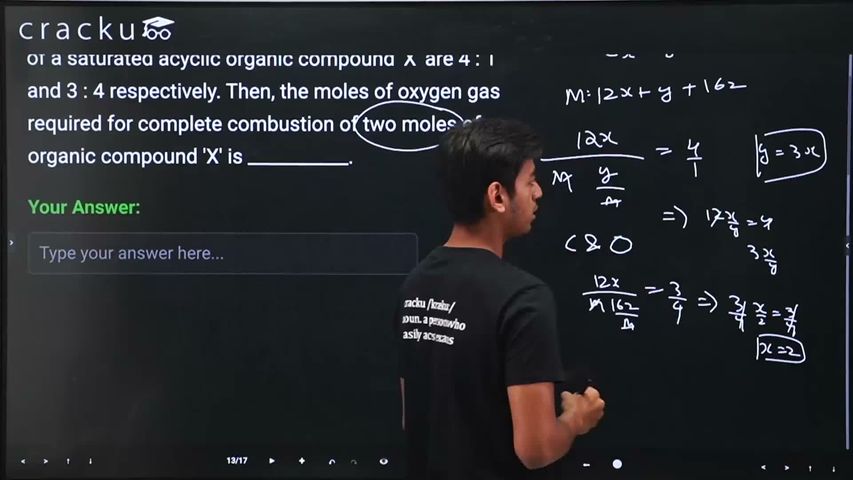
The ratio of the mass percentages of 'C & H' and 'C & O' of a saturated acyclic organic compound 'X' are 4 : 1 and 3 : 4 respectively. Then, the moles of oxygen gas required for complete combustion of two moles of organic compound 'X' is ___________.
Correct Answer: 5
Let the molecular formula of the saturated, open-chain organic compound be $$\mathrm{C}_x\mathrm{H}_y\mathrm{O}_z$$.
Its molar mass (in atomic-mass units) is $$12x + y + 16z$$.
Mass percentage of any element is obtained from
$$\text{mass\% of element}=\dfrac{\text{mass of that element in 1 mole}}{\text{molar mass}}\times 100.$$
We have the given ratio of the mass percentages of carbon and hydrogen
$$\dfrac{\%\,\mathrm{C}}{\%\,\mathrm{H}}=\dfrac{4}{1}.$$
Using the formula, this ratio becomes
$$\dfrac{\dfrac{12x}{12x+y+16z}}{\dfrac{y}{12x+y+16z}}=\dfrac{4}{1}.$$
The common denominator cancels, giving
$$\dfrac{12x}{y}=4.$$
So
$$12x = 4y \;\;\Longrightarrow\;\; y = 3x.$$
Next, the ratio of the mass percentages of carbon and oxygen is supplied as
$$\dfrac{\%\,\mathrm{C}}{\%\,\mathrm{O}}=\dfrac{3}{4}.$$
This becomes
$$\dfrac{\dfrac{12x}{12x+y+16z}}{\dfrac{16z}{12x+y+16z}}=\dfrac{3}{4}.$$
Again the denominator cancels, leaving
$$\dfrac{12x}{16z}=\dfrac{3}{4}.$$
Cross-multiplying gives
$$12x \times 4 = 16z \times 3 \;\;\Longrightarrow\;\; 48x = 48z \;\;\Longrightarrow\;\; x = z.$$
Substituting $$y=3x$$ and $$z=x$$, the empirical formula is obtained as
$$\mathrm{C}_x\mathrm{H}_{3x}\mathrm{O}_x.$$
Dividing every subscript by the common factor $$x$$ gives the simplest whole-number ratio
$$\mathrm{CH}_3\mathrm{O}.$$
Because a real molecule must satisfy the valencies exactly, we multiply this unit by the smallest integer that produces a fully saturated, acyclic structure with single bonds only. Taking $$n=2$$ delivers the molecule
$$\mathrm{C}_2\mathrm{H}_6\mathrm{O}_2,$$
which is indeed a saturated open-chain compound (for instance, ethane-1,2-diol).
Now we balance its complete combustion. For one mole, write
$$\mathrm{C}_2\mathrm{H}_6\mathrm{O}_2 + a\,\mathrm{O}_2 \;\longrightarrow\; 2\,\mathrm{CO}_2 + 3\,\mathrm{H}_2\mathrm{O}.$$\;
On the right there are $$2\times2=4$$ oxygen atoms in $$\mathrm{CO}_2$$ and $$3\times1=3$$ oxygen atoms in $$\mathrm{H}_2\mathrm{O},$$ a total of $$4+3=7$$ oxygen atoms.
The organic molecule already supplies $$2$$ oxygen atoms, so the remaining $$7-2 = 5$$ oxygen atoms must come from molecular oxygen:
$$\dfrac{5}{2}\,\mathrm{O}_2.$$
Therefore, for one mole of $$\mathrm{C}_2\mathrm{H}_6\mathrm{O}_2$$ we need $$\dfrac{5}{2}$$ moles of $$\mathrm{O}_2.$$
For two moles of the organic compound the amount of oxygen required is
$$2 \times \dfrac{5}{2} = 5 \text{ moles of } \mathrm{O}_2.$$
So, the answer is $$5$$.
Was this solution helpful?
Click on the Email ☝️ to Watch the Video Solution
Create a FREE account and get:
_1.webp)

Educational materials for JEE preparation

Ask our AI anything

AI can make mistakes. Please verify important information.
AI can make mistakes. Please verify important information.


