Join Our JEE Preparation Group
Prep with like-minded aspirants; Get access to free daily tests and study material.
Sign in
Please select an account to continue using cracku.in
↓ →
Join Our JEE Preparation Group
Prep with like-minded aspirants; Get access to free daily tests and study material.
The reaction sequence can be understood by following the transformation of the functional group at each stage.
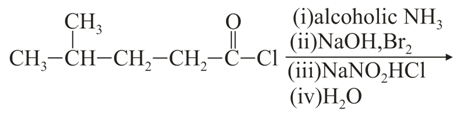
In the first step, 4-methylpentanoyl chloride reacts with alcoholic ammonia.
This is a nucleophilic acyl substitution reaction in which ammonia attacks the carbonyl carbon and replaces the chloride ion, producing the corresponding primary amide.
Thus, the first intermediate formed is
$$\boxed{\mathrm{CH_3-CH(CH_3)-CH_2-CH_2-CONH_2},}$$
which is 4-methylpentanamide.
In the second step, the amide is treated with
$$\mathrm{Br_2/NaOH}.$$
These reagents carry out the Hoffmann bromamide degradation, converting a primary amide into a primary amine containing one carbon atom less than the original amide.
The carbonyl carbon is eliminated during the reaction.
Hence, the second intermediate is
$$\boxed{\mathrm{CH_3-CH(CH_3)-CH_2-CH_2-NH_2},}$$
which is 3-methylbutan-1-amine.
In the third step, the primary aliphatic amine is treated with
$$\mathrm{NaNO_2/HCl},$$
which generates nitrous acid in situ.
The amine undergoes diazotization to form an unstable aliphatic diazonium salt. This intermediate immediately loses nitrogen gas to produce a carbocation.
In the presence of water, the carbocation is attacked by a water molecule, resulting in hydrolysis to the corresponding alcohol.
Therefore, the final product obtained is
$$\boxed{\mathrm{CH_3-CH(CH_3)-CH_2-CH_2-OH},}$$
which is 3-methylbutan-1-ol.
Hence, the correct answer is
$$\boxed{\text{Option (C).}}$$
Create a FREE account and get:
_1.webp)

Educational materials for JEE preparation

Ask our AI anything

AI can make mistakes. Please verify important information.
AI can make mistakes. Please verify important information.