
Join Our JEE Preparation Group
Prep with like-minded aspirants; Get access to free daily tests and study material.
Sign in
Please select an account to continue using cracku.in
↓ →
Join Our JEE Preparation Group
Prep with like-minded aspirants; Get access to free daily tests and study material.
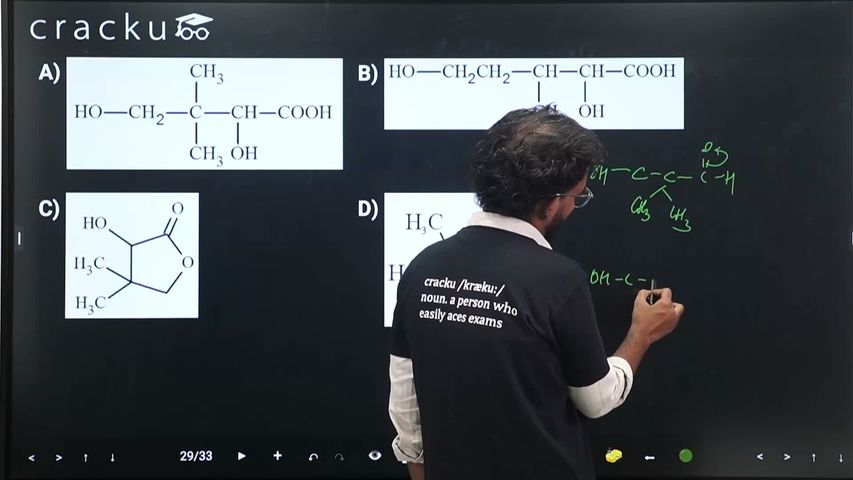
Isobutyraldehyde on reaction with formaldehyde and K$$_2$$CO$$_3$$ gives compound 'A'. Compound 'A' reacts with KCN and yields compound 'B', which on hydrolysis gives a stable compound 'C'. The compound 'C' is
Isobutyraldehyde, (CH3)2CH-CHO, has exactly one acidic α-hydrogen. In the presence of a mild base (K2CO3), it forms an enolate which selectively attacks the more reactive, non-enolizable formaldehyde (HCHO).
The aldehyde group of Compound 'A' is targeted by nucleophilic cyanide ions (CN¯) from KCN, producing a cyanohydrin intermediate containing both a nitrile moiety and hydroxyl components.
During aqueous acid treatment, two shifts happen in rapid succession:
Because the hydroxyl attachment generated on the original isobutyraldehyde core ends up next to the gem-dimethyl group while the initial primary alcohol site closing the ring system targets the carbonyl terminus, the connectivity perfectly maps out to match the configuration shown in Option C.
Was this solution helpful?
Click on the Email ☝️ to Watch the Video Solution
Create a FREE account and get:
_1.webp)

Educational materials for JEE preparation

Ask our AI anything

AI can make mistakes. Please verify important information.
AI can make mistakes. Please verify important information.
