Join Our JEE Preparation Group
Prep with like-minded aspirants; Get access to free daily tests and study material.
Sign in
Please select an account to continue using cracku.in
↓ →
Join Our JEE Preparation Group
Prep with like-minded aspirants; Get access to free daily tests and study material.
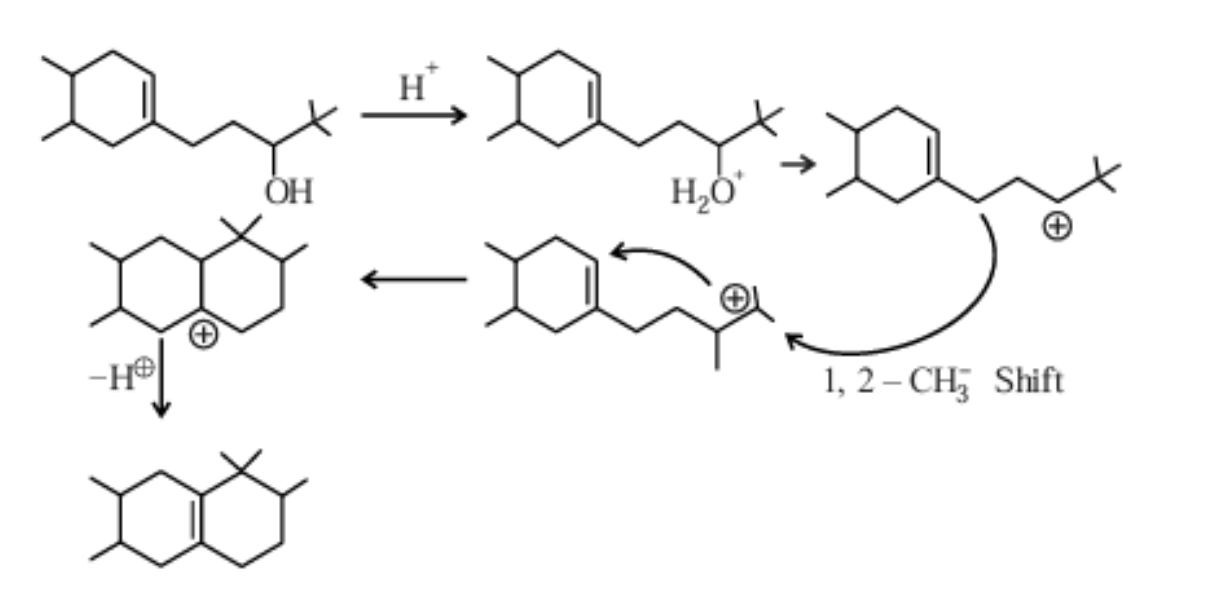
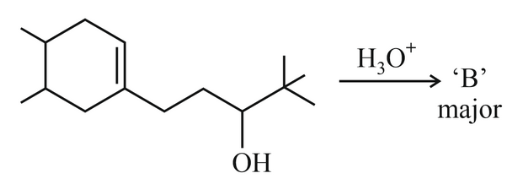
1. Protonation of the Alcohol
The lone pair of electrons on the oxygen atom of the secondary alcohol $$(-\text{OH}$$) attacks a hydronium ion $$(\text{H}^{+}$$).
The hydroxyl group is converted into an excellent leaving group, a protonated water molecule $$(-\text{OH}_{2}^{+}$$).
2. Loss of Water (Carbocation Formation)
The $$\text{C}-\text{O}$$ bond breaks, and water $$(\text{H}_2\text{O}$$) leaves.
A secondary $$(2^{\circ }$$) carbocation is formed on the carbon chain adjacent to the bulky tert-butyl group.
3. 1,2-Methyl $$(\text{CH}_{3}^{-}$$) Shift
A secondary carbocation is relatively unstable. To gain stability, a methyl group from the adjacent tert-butyl group migrates with its electron pair (a 1,2-methyl shift) to the carbocation carbon.
This rearranges the less stable $$2^{\circ }$$ carbocation into a highly stable tertiary $$(3^{\circ })$$ carbocation at the terminal branch.
4. Intramolecular Cyclization (Ring Closure)
The $$\pi$$-electrons of the cyclohexene double bond act as an intramolecular nucleophile, attacking the newly formed tertiary carbocation.
This nucleophilic attack closes the chain into a second 6-membered ring (forming a fused decalin system). A new tertiary carbocation is generated at the ring junction (bridgehead position).
5. Deprotonation $$(-\text{H}^{+})$$ to Form the Major Product
A weak base (such as water) removes a proton $$(\text{H}^{+})$$ from the adjacent carbon atom at the ring junction.
Elimination of the proton forms a highly stable, tetrasubstituted double bond directly at the shared bridgehead position between the two fused 6-membered rings.
Was this solution helpful?
Click on the Email ☝️ to Watch the Video Solution
Create a FREE account and get:
_1.webp)

Educational materials for JEE preparation

Ask our AI anything

AI can make mistakes. Please verify important information.
AI can make mistakes. Please verify important information.