
Join Our JEE Preparation Group
Prep with like-minded aspirants; Get access to free daily tests and study material.
Sign in
Please select an account to continue using cracku.in
↓ →
Join Our JEE Preparation Group
Prep with like-minded aspirants; Get access to free daily tests and study material.
Find out the major products from the following reaction sequence.
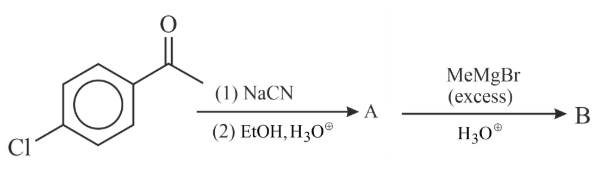

Step 1: Cyanohydrin Formation and Alcoholysis ($$\text{1) NaCN}$$, $$\text{2) EtOH, H}_2\text{O, H}^\oplus$$)
The starting material is a ketone, 4-chloroacetophenone ($$\text{Cl--C}_6\text{H}_4\text{--COCH}_3$$).
This gives the first intermediate shown in the scheme: ethyl 2-(4-chlorophenyl)-2-hydroxypropanoate.
Step 2: Grignard Reaction with Excess Methylmagnesium Bromide ($$\text{MeMgBr (excess)}$$ followed by $$\text{H}_3\text{O}^\oplus$$)
The intermediate contains two key functional groups: a tertiary alcohol ($$\text{--OH}$$) and an ester ($$\text{--CO}_2\text{Et}$$).
After acidic workup ($$\text{H}_3\text{O}^\oplus$$), the final product contains a highly branched tertiary alcohol unit attached to the original aromatic framework.
The carbon atom alpha to the benzene ring preserves its original hydroxyl group ($$\text{--OH}$$) and methyl group ($$\text{--Me}$$). The ester group ($$\text{--CO}_2\text{Et}$$) is converted completely into a 2-hydroxypropan-2-yl group ($$\text{--C(OH)Me}_2$$).
Therefore, the structural formula of the final major product is:
$$\text{Cl--C}_6\text{H}_4\text{--C(OH)(Me)--C(OH)(Me)}_2$$
The reaction sequence effectively introduces multiple methyl groups by transforming the ester functionality into a tertiary alcohol while maintaining the structural integrity of the chloro-substituted benzene ring.
Answer: The molecular structure labeled as 'C' in the reaction scheme, which corresponds to $$\text{Cl--C}_6\text{H}_4\text{--C(OH)(Me)--C(OH)(Me)}_2$$.
Was this solution helpful?
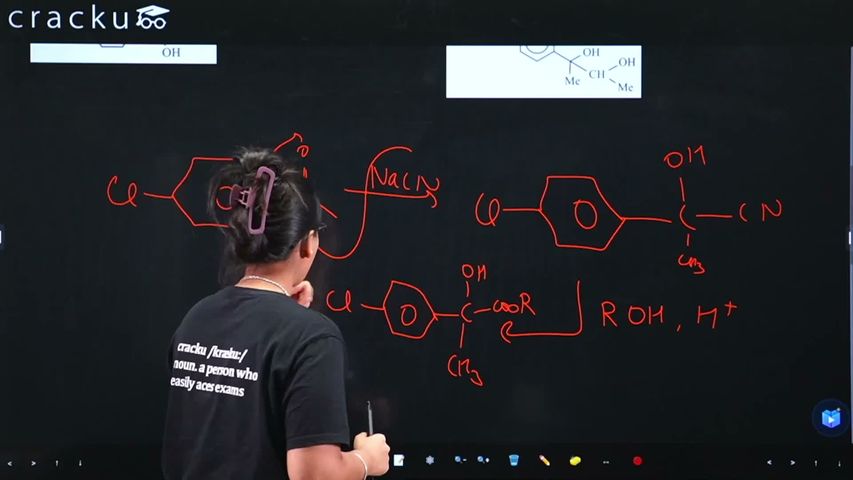
Click on the Email ☝️ to Watch the Video Solution
Create a FREE account and get:
_1.webp)

Educational materials for JEE preparation

Ask our AI anything

AI can make mistakes. Please verify important information.
AI can make mistakes. Please verify important information.
