Join Our JEE Preparation Group
Prep with like-minded aspirants; Get access to free daily tests and study material.
Sign in
Please select an account to continue using cracku.in
↓ →
Join Our JEE Preparation Group
Prep with like-minded aspirants; Get access to free daily tests and study material.
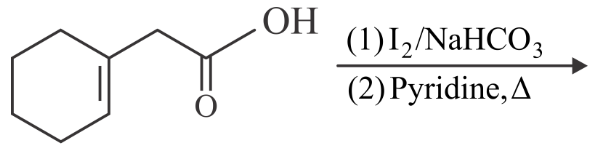
Explanation: The reaction begins with iodolactonization.
The carboxylic acid is converted into a carboxylate ion by $$NaHCO_3$$.
The alkene reacts with $$I_2$$ to form an iodonium ion intermediate.
The carboxylate ion attacks intramolecularly to form a stable five-membered lactone ring, placing iodine on the more substituted carbon.
In the next step, pyridine and heat promote dehydrohalogenation $$-HI$$ is eliminated to form a double bond.
Elimination occurs preferentially at the $$\alpha$$-carbon adjacent to the carbonyl group because it produces an $$\alpha,\beta$$-unsaturated lactone. The resulting conjugated system is thermodynamically more stable than non-conjugated alternatives.
Therefore, the major product is the conjugated $$\alpha,\beta$$-unsaturated lactone corresponding to Option C.
Was this solution helpful?
Create a FREE account and get:
_1.webp)

Educational materials for JEE preparation

Ask our AI anything

AI can make mistakes. Please verify important information.
AI can make mistakes. Please verify important information.