Join Our JEE Preparation Group
Prep with like-minded aspirants; Get access to free daily tests and study material.
Sign in
Please select an account to continue using cracku.in
↓ →
Join Our JEE Preparation Group
Prep with like-minded aspirants; Get access to free daily tests and study material.
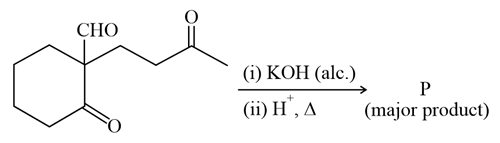
To determine the major product of this reaction, we first identify the reactive sites present in the starting compound.
The given molecule is a tri-carbonyl compound containing a cyclohexanone ring. The carbon adjacent to the ketone group of the ring is a quaternary carbon attached to:
1. An aldehyde group
2. A $$\mathrm{3\text{-}oxobutyl}$$ side chain containing a methyl ketone
Step 1: Formation of the Enolate Ion
Alcoholic potassium hydroxide acts as a base and removes an acidic alpha-hydrogen to generate an enolate ion.
Among the available alpha-hydrogens, deprotonation occurs preferentially at the terminal methyl group of the side chain because it is less sterically hindered and forms a stable enolate.
$$\mathrm{CH_3COCH_2CH_2-C^*(CHO)-Cyclohexanone \xrightarrow{KOH/Alcohol} CH_2^-COCH_2CH_2-C^*(CHO)-Cyclohexanone}$$
Step 2: Intramolecular Aldol Condensation
The generated enolate undergoes intramolecular nucleophilic attack on the aldehyde carbonyl group.
Aldehydes are more reactive than ketones because they possess less steric hindrance and fewer electron-donating alkyl groups.
Thus, the enolate attacks the aldehyde carbonyl carbon selectively.
$$\mathrm{CH_2^-COCH_2CH_2-C^*(CHO)-Cyclohexanone \longrightarrow \beta\text{-}Hydroxy\ Spiro\ Intermediate}$$
This intramolecular cyclisation forms a new six-membered ring.
Since the newly formed ring and the original cyclohexanone ring share only one common carbon atom, the product obtained is a spiro compound.
Step 3: Dehydration
Under acidic conditions and heat, the beta-hydroxy ketone undergoes dehydration.
A molecule of water is eliminated, producing an alpha,beta-unsaturated ketone.
$$\mathrm{\beta\text{-}Hydroxy\ Spiro\ Intermediate \xrightarrow{H^+,\ \Delta} Spiro\ Enone + H_2O}$$
The elimination occurs between:
1. The hydroxyl group formed from the aldehyde carbonyl
2. A neighbouring hydrogen atom on the attacking carbon
This produces a conjugated double bond, increasing the stability of the final product.
Overall Transformation:
$$\mathrm{Tri\text{-}carbonyl\ Compound \xrightarrow[\ H^+,\ \Delta\ ]{KOH/Alcohol} Spiro[5.5]undec\text{-}en\text{-}one\ Derivative}$$
Final Major Product:
The final major product is a $$\mathrm{spiro[5.5]undecane}$$ derivative consisting of:
1. The original cyclohexanone ring
2. A newly formed cyclohex-2-en-1-one ring
Both rings are connected through a single spiro carbon atom.
The newly formed ring contains an $$\mathrm{\alpha,\beta}$$-unsaturated ketone system, making the final product highly stabilised through conjugation.
Was this solution helpful?
Create a FREE account and get:
_1.webp)

Educational materials for JEE preparation

Ask our AI anything

AI can make mistakes. Please verify important information.
AI can make mistakes. Please verify important information.