Join Our JEE Preparation Group
Prep with like-minded aspirants; Get access to free daily tests and study material.
Sign in
Please select an account to continue using cracku.in
↓ →
Join Our JEE Preparation Group
Prep with like-minded aspirants; Get access to free daily tests and study material.
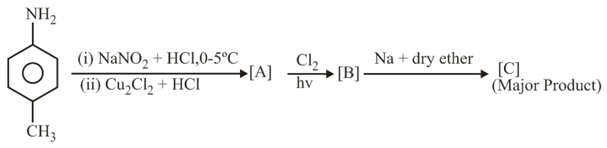
To determine the major product $$[C]$$, we analyze the reaction sequence step by step starting from p-toluidine ($$4$$-methylaniline).
Treatment of p-toluidine with $$NaNO_2+HCl$$ at $$0{-}5^\circ\text{C}$$ converts the amino group into the corresponding diazonium salt. Subsequent reaction with $$Cu_2Cl_2+HCl$$ carries out the Sandmeyer reaction, replacing the diazonium group with chlorine to give 1-chloro-4-methylbenzene (p-chlorotoluene) as intermediate $$[A]$$.
In the next step, intermediate $$[A]$$ is treated with $$Cl_2/h\nu$$. Under these free-radical conditions, substitution occurs preferentially at the benzylic position rather than on the aromatic ring, converting the methyl group into a chloromethyl group. Hence, intermediate $$[B]$$ is 1-chloro-4-(chloromethyl)benzene.
Finally, treatment of $$[B]$$ with sodium metal in dry ether results in a Wurtz coupling reaction. Two molecules of the benzylic chloride couple together at the benzylic carbon atoms to form the corresponding dimer.
The resulting product $$[C]$$ is 1,2-bis(4-chlorophenyl)ethane, having the structure
$$Cl-C_6H_4-CH_2-CH_2-C_6H_4-Cl.$$
Therefore, the major product $$[C]$$ is 1,2-bis(4-chlorophenyl)ethane, corresponding to Option A.
Was this solution helpful?
Create a FREE account and get:
_1.webp)

Educational materials for JEE preparation

Ask our AI anything

AI can make mistakes. Please verify important information.
AI can make mistakes. Please verify important information.