Join Our JEE Preparation Group
Prep with like-minded aspirants; Get access to free daily tests and study material.
Sign in
Please select an account to continue using cracku.in
↓ →
Join Our JEE Preparation Group
Prep with like-minded aspirants; Get access to free daily tests and study material.
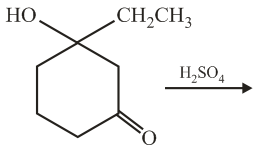
To determine the major product of the given reaction, we analyze the acid-catalyzed dehydration of the substituted cyclohexanone containing a tertiary alcohol group.
When treated with concentrated $$H_2SO_4$$, the reaction proceeds through an E1 elimination mechanism. Initially, the hydroxyl group is protonated by the acid, converting the poor leaving group $$-OH$$ into the better leaving group $$-OH_2^+$$. Loss of water then generates a stable tertiary carbocation at the carbon bearing the hydroxyl group.
The resulting carbocation can undergo elimination by the removal of a proton from either of the adjacent carbon atoms. According to Zaitsev's rule, the preferred pathway is the one that forms the more substituted and thermodynamically more stable alkene.
In this case, elimination can produce either an exocyclic double bond or an endocyclic double bond. Formation of the endocyclic double bond is favored because it generates an $$\alpha,\beta$$-unsaturated ketone, allowing conjugation between the newly formed $$C=C$$ bond and the existing carbonyl group. This conjugated enone system is significantly more stable than the alternative non-conjugated product.
Therefore, the major product is 3-ethylcyclohex-2-en-1-one, which consists of a cyclohexenone ring bearing an ethyl substituent at the $$3$$-position and a conjugated double bond adjacent to the carbonyl group.
Hence, the correct answer is the conjugated enone structure, i.e., 3-ethylcyclohex-2-en-1-one.
Was this solution helpful?
Create a FREE account and get:
_1.webp)

Educational materials for JEE preparation

Ask our AI anything

AI can make mistakes. Please verify important information.
AI can make mistakes. Please verify important information.