Join Our JEE Preparation Group
Prep with like-minded aspirants; Get access to free daily tests and study material.
Sign in
Please select an account to continue using cracku.in
↓ →
Join Our JEE Preparation Group
Prep with like-minded aspirants; Get access to free daily tests and study material.
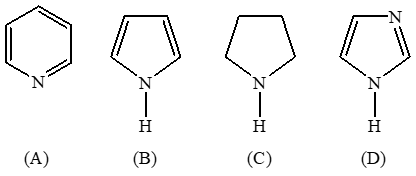
To determine the increasing order of basicity of the given compounds, we compare the availability of the nitrogen lone pair for protonation. A compound is more basic when its lone pair is more readily available to accept a proton.
In pyrrole (B), the lone pair on the nitrogen atom is a part of the aromatic $$\pi$$-electron sextet. Since it is delocalized to maintain aromaticity, it is not readily available for protonation, making pyrrole the least basic among the given compounds.
In pyridine (A), the nitrogen atom is $$sp^2$$ hybridized, and its lone pair lies in an $$sp^2$$ orbital outside the aromatic $$\pi$$ system. Although available for protonation, the higher $$s$$-character of the $$sp^2$$ orbital holds the lone pair closer to the nucleus, reducing its basicity compared to $$sp^3$$-hybridized amines.
Imidazole (D) contains two nitrogen atoms. One nitrogen behaves like that in pyrrole, with its lone pair participating in aromaticity, while the other behaves like that in pyridine, with its lone pair available for protonation. Resonance within the ring stabilizes the protonated form, making imidazole more basic than pyridine.
In pyrrolidine (C), the nitrogen atom is $$sp^3$$ hybridized and its lone pair is not involved in aromaticity. Because the lone pair resides in an $$sp^3$$ orbital with lower $$s$$-character, it is more diffuse and more readily available for protonation, making pyrrolidine the most basic compound.
Therefore, the increasing order of basicity is
$$\boxed{B < A < D < C}.$$
Hence, the correct order is
Pyrrole < Pyridine < Imidazole < Pyrrolidine.
Was this solution helpful?
Create a FREE account and get:
_1.webp)

Educational materials for JEE preparation

Ask our AI anything

AI can make mistakes. Please verify important information.
AI can make mistakes. Please verify important information.