
Join Our JEE Preparation Group
Prep with like-minded aspirants; Get access to free daily tests and study material.
Sign in
Please select an account to continue using cracku.in
↓ →
Join Our JEE Preparation Group
Prep with like-minded aspirants; Get access to free daily tests and study material.
To identify the incorrect statement, we need to examine the chemical properties of halogens and interhalogen compounds.
First, let us compare the reactivity of $$Cl_2$$ and $$ClF$$.
Interhalogen compounds such as $$ClF$$ are generally more reactive than the corresponding diatomic halogens because the bond between two different halogen atoms is polar and weaker than the bond between identical halogen atoms.
The $$Cl-F$$ bond is weaker and more easily cleaved than the $$Cl-Cl$$ bond, making $$ClF$$ more reactive than $$Cl_2$$.
The only important exception is fluorine. The $$F-F$$ bond is unusually weak because of strong lone pair-lone pair repulsions between the two small fluorine atoms. As a result, $$F_2$$ is the most reactive halogen.
Therefore,
Hence, the statement saying that $$Cl_2$$ is more reactive than $$ClF$$ is incorrect, while the statement that $$F_2$$ is more reactive than $$ClF$$ is correct.
Now consider the oxidizing power.
Fluorine is the strongest oxidizing agent among all the halogens. Its very high standard reduction potential arises from its low bond dissociation enthalpy and the large hydration enthalpy of the fluoride ion.
Therefore,
$$F_2$$ is a stronger oxidizing agent than $$Cl_2$$ in aqueous solution.
So, Statement (A) is correct.
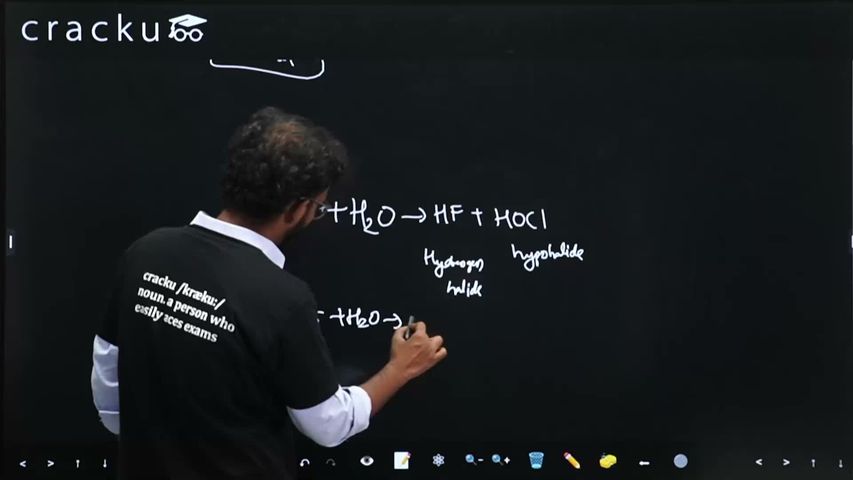
Next, consider the hydrolysis of $$ClF$$.
During hydrolysis of an interhalogen compound, the more electronegative halogen forms the hydrohalic acid, while the less electronegative halogen forms the hypohalous acid.
Thus,
$$ClF + H_2O \rightarrow HF + HOCl.$$
Hence, Statement (B) is also correct.
Therefore, the only incorrect statement is that $$Cl_2$$ is more reactive than $$ClF$$.
The correct answer is Option (C).
Was this solution helpful?
Click on the Email ☝️ to Watch the Video Solution
Create a FREE account and get:
_1.webp)

Educational materials for JEE preparation

Ask our AI anything

AI can make mistakes. Please verify important information.
AI can make mistakes. Please verify important information.
