Join Our JEE Preparation Group
Prep with like-minded aspirants; Get access to free daily tests and study material.
Sign in
Please select an account to continue using cracku.in
↓ →
Join Our JEE Preparation Group
Prep with like-minded aspirants; Get access to free daily tests and study material.
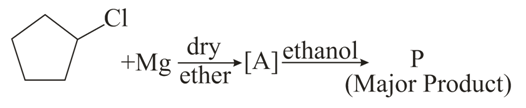
The reaction sequence can be understood by analyzing each step separately.
In the first step, chlorocyclopentane reacts with magnesium in dry ether.
According to NCERT, alkyl halides react with magnesium in dry ether to form Grignard reagents (alkylmagnesium halides).
Thus,
$$\text{Chlorocyclopentane} + Mg \xrightarrow{\text{dry ether}} \text{Cyclopentylmagnesium chloride}.$$
Therefore, intermediate $$A$$ is cyclopentylmagnesium chloride.
In the second step, the Grignard reagent is treated with ethanol ($CH_3CH_2OH$).
Grignard reagents contain a highly polar carbon-magnesium bond, making the carbon atom strongly basic. Consequently, they readily react with compounds containing acidic hydrogen atoms.
Ethanol contains an acidic proton in its hydroxyl group, so an acid-base reaction occurs immediately.
The cyclopentyl group abstracts the proton from ethanol, producing cyclopentane:
$$\text{CyclopentylMgCl} + CH_3CH_2OH \longrightarrow \text{Cyclopentane} + CH_3CH_2OMgCl.$$
No substitution involving the ethyl group takes place because proton transfer is much faster and thermodynamically favored.
Hence, the major product $$P$$ is cyclopentane.
Therefore, the correct answer is:
(C) Cyclopentane
Was this solution helpful?
Create a FREE account and get:
_1.webp)

Educational materials for JEE preparation

Ask our AI anything

AI can make mistakes. Please verify important information.
AI can make mistakes. Please verify important information.