
Join Our JEE Preparation Group
Prep with like-minded aspirants; Get access to free daily tests and study material.
Sign in
Please select an account to continue using cracku.in
↓ →
Join Our JEE Preparation Group
Prep with like-minded aspirants; Get access to free daily tests and study material.
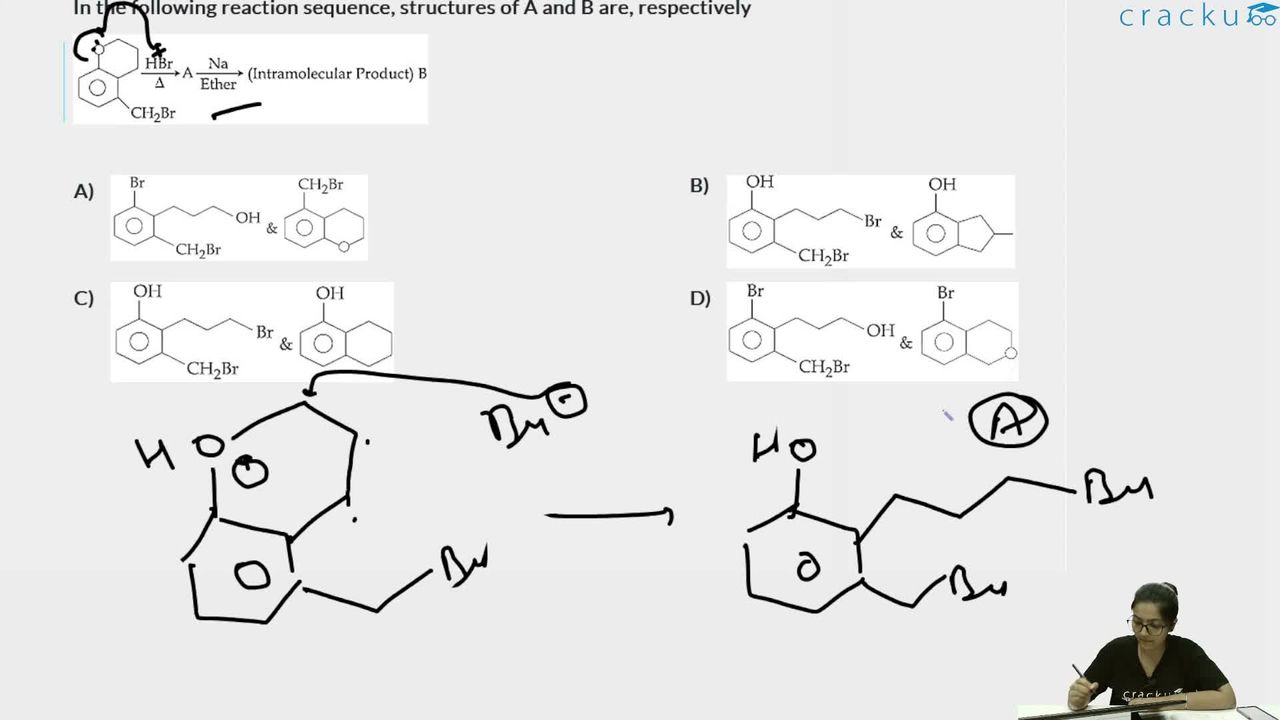
In the following reaction sequence, structures of A and B are, respectively
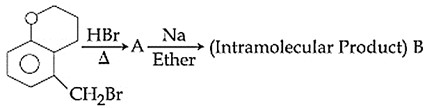
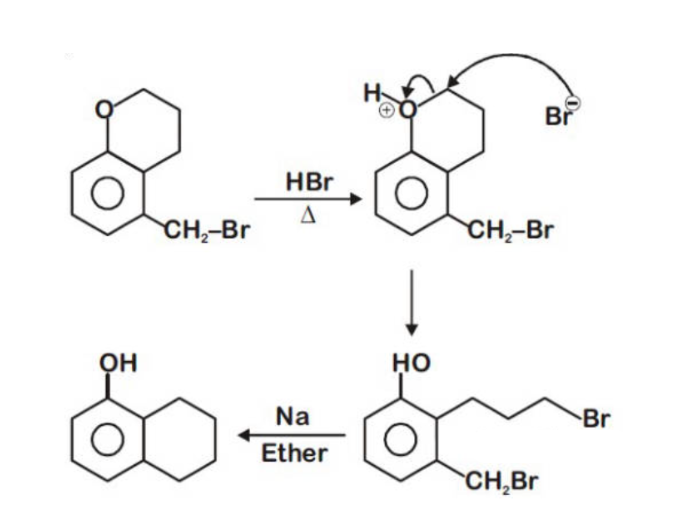
We need to determine the structures of the intermediates or products in the given intramolecular coupling reaction mediated by sodium in ether.
Radical Formation:
When the starting material containing two alkyl bromide groups ($$\text{--CH}_2\text{Br}$$ and the side-chain terminal $$\text{--Br}$$) is treated with metallic sodium ($$\text{Na}$$) in an anhydrous solvent like ether, sodium donates electrons to the carbon-halogen bonds. This generates reactive radical or organosodium intermediates at both alkyl carbon centers.
Intramolecular Ring Closure (Cyclization):
The two highly reactive radical centers (or the carbanion and the remaining alkyl halide) undergo a rapid, favorable intramolecular homolytic/heterolytic carbon-carbon ($$\text{C--C}$$) bond coupling. This brings the two side chains together to close a new six-membered saturated ring fused directly to the existing benzene ring:
$$\text{Bis-brominated Precursor} \xrightarrow{\text{Na / Ether}} \text{Fused Bicyclic Tetralin Core} + 2\text{NaBr}$$The reaction is a classic example of an intramolecular Wurtz coupling that efficiently constructs a stable six-membered ring fused to the phenolic framework, yielding a tetrahydronaphthol derivative.
Answer: The option showing the corresponding structures matching the intramolecular cyclization pathway (Option C).
Was this solution helpful?
Click on the Email ☝️ to Watch the Video Solution
Create a FREE account and get:
_1.webp)

Educational materials for JEE preparation

Ask our AI anything

AI can make mistakes. Please verify important information.
AI can make mistakes. Please verify important information.
