Join Our JEE Preparation Group
Prep with like-minded aspirants; Get access to free daily tests and study material.
Sign in
Please select an account to continue using cracku.in
↓ →
Join Our JEE Preparation Group
Prep with like-minded aspirants; Get access to free daily tests and study material.
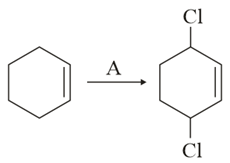
The reaction shown is an allylic substitution reaction.
The starting compound is cyclohexene.
In the product, the double bond remains unchanged, while chlorine atoms replace the hydrogens at the allylic positions.
Allylic positions are the carbon atoms adjacent to the: $$\mathrm{C=C}$$ bond.
(A) $$\mathrm{HCl}$$ would undergo electrophilic addition across the double bond.
$$\mathrm{Cyclohexene + HCl \longrightarrow Chlorocyclohexane}$$ The double bond would be destroyed.
Hence, this does not give the required product.
(B) $$\mathrm{HCl/Peroxide}$$ does not produce allylic substitution in alkenes.
It also leads to addition reactions. Hence, incorrect.
(D) $$\mathrm{Cl_2}$$ in dark undergoes electrophilic addition across the double bond.
$$\mathrm{Cyclohexene + Cl_2 \longrightarrow 1,2\text{-}Dichlorocyclohexane}$$
Thus, the double bond disappears. Hence, incorrect.
(C)
$$\mathrm{Cl_2/h\nu}$$ proceeds through a free radical mechanism.
UV light causes homolytic cleavage:
$$\mathrm{Cl_2 \xrightarrow{h\nu} 2Cl^\bullet}$$
The chlorine radical abstracts an allylic hydrogen to form a resonance-stabilised allylic radical.
$$\mathrm{Allylic\ Radical \rightleftharpoons Resonance\ Forms}$$
This radical then reacts with another:
$$\mathrm{Cl_2}$$
molecule to form allylic chloride while retaining the double bond. Hence, allylic chlorination occurs.
Therefore, the correct reagent is: $$\mathrm{Cl_2/h\nu}$$
Correct option: $$\mathrm{C}$$
Was this solution helpful?
Click on the Email ☝️ to Watch the Video Solution
Create a FREE account and get:
_1.webp)

Educational materials for JEE preparation

Ask our AI anything

AI can make mistakes. Please verify important information.
AI can make mistakes. Please verify important information.