
Join Our JEE Preparation Group
Prep with like-minded aspirants; Get access to free daily tests and study material.
Sign in
Please select an account to continue using cracku.in
↓ →
Join Our JEE Preparation Group
Prep with like-minded aspirants; Get access to free daily tests and study material.
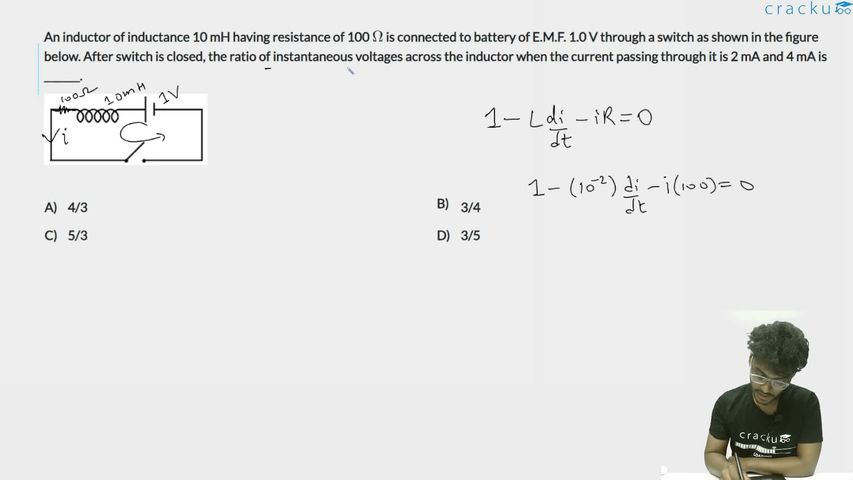
An inductor of inductance 10 mH having resistance of 100 $$\Omega$$ is connected to battery of E.M.F. 1.0 V through a switch as shown in the figure below. After switch is closed, the ratio of instantaneous voltages across the inductor when the current passing through it is 2 mA and 4 mA is _______.
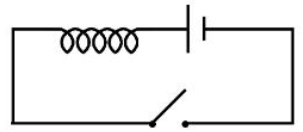
Given parameters for the series RL circuit:
Inductance, $$ L = 10 \text{ mH} $$
Resistance, $$ R = 100 \ \Omega $$
Battery E.M.F., $$ E = 1.0 \text{ V} $$
According to Kirchhoff's Voltage Law (KVL)
$$ E = V_R + V_L $$
Where:
$$ V_R $$ is the voltage across the resistor ($$ V_R = iR $$)
$$ V_L $$ is the instantaneous voltage across the inductor
Rearranging the equation to solve for $$ V_L $$:
$$ V_L = E - iR $$
$$ V_{L1} = E - i_1 R $$
$$ V_{L1} = 1.0 - (2 \times 10^{-3})(100) $$
$$ V_{L1} = 1.0 - 0.2 $$
$$ V_{L1} = 0.8 \text{ V} $$
$$ V_{L2} = E - i_2 R $$
$$ V_{L2} = 1.0 - (4 \times 10^{-3})(100) $$
$$ V_{L2} = 1.0 - 0.4 $$
$$ V_{L2} = 0.6 \text{ V} $$
Now, we calculate the ratio of these instantaneous voltages:
$$ \text{Ratio} = \frac{V_{L1}}{V_{L2}} $$
$$ \text{Ratio} = \frac{0.8 \text{ V}}{0.6 \text{ V}} $$
$$ \text{Ratio} = \frac{8}{6} $$
$$ \text{Ratio} = \frac{4}{3} $$
Was this solution helpful?
Click on the Email ☝️ to Watch the Video Solution
Create a FREE account and get:
_1.webp)

Educational materials for JEE preparation

Ask our AI anything

AI can make mistakes. Please verify important information.
AI can make mistakes. Please verify important information.


