
Join Our JEE Preparation Group
Prep with like-minded aspirants; Get access to free daily tests and study material.
Sign in
Please select an account to continue using cracku.in
↓ →
Join Our JEE Preparation Group
Prep with like-minded aspirants; Get access to free daily tests and study material.
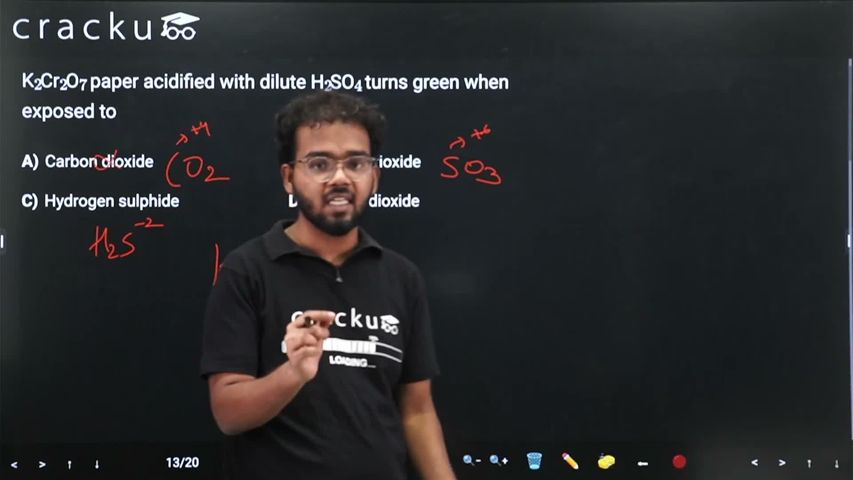
K$$_2$$Cr$$_2$$O$$_7$$ paper acidified with dilute H$$_2$$SO$$_4$$ turns green when exposed to
Acidified potassium dichromate is a strong oxidizing agent. The dichromate ion $$Cr_2O_7^{2-}$$ contains chromium in the +6 oxidation state and is orange in colour. When it oxidizes a reducing agent, it is reduced to $$Cr^{3+}$$, which is green in colour.
Therefore, the gas that turns acidified potassium dichromate paper from orange to green must act as a reducing agent.
Evaluating the given gases:
• $$CO_2$$: Carbon is already in its highest oxidation state (+4) and cannot be oxidized further. Hence, it does not reduce dichromate.
• $$SO_3$$: Sulphur is already in its highest oxidation state (+6) and cannot be oxidized further. Hence, it does not reduce dichromate.
• $$H_2S$$: Sulphur is in the -2 oxidation state and readily acts as a reducing agent. It reduces dichromate, but is simultaneously oxidized to elemental sulphur, producing a yellow deposit.
• $$SO_2$$: Sulphur is in the +4 oxidation state and can be oxidized to +6. Therefore, it acts as a reducing agent and reduces dichromate to green $$Cr^{3+}$$ ions. This is the standard qualitative test for sulphur dioxide.
The reaction is:
$$K_2Cr_2O_7 + 3SO_2 + H_2SO_4 \rightarrow K_2SO_4 + Cr_2(SO_4)_3 + H_2O$$
The orange dichromate ion is converted into green chromium(III) ions, causing the colour change.
Hence, the gas that turns acidified potassium dichromate paper green is
$$\boxed{SO_2}$$
Therefore, the correct answer is $$\boxed{\text{Sulphur dioxide}}$$.
Was this solution helpful?
Click on the Email ☝️ to Watch the Video Solution
Create a FREE account and get:
_1.webp)

Educational materials for JEE preparation

Ask our AI anything

AI can make mistakes. Please verify important information.
AI can make mistakes. Please verify important information.
