Join Our JEE Preparation Group
Prep with like-minded aspirants; Get access to free daily tests and study material.
Sign in
Please select an account to continue using cracku.in
↓ →
Join Our JEE Preparation Group
Prep with like-minded aspirants; Get access to free daily tests and study material.
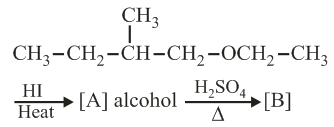
To determine the major product of the given reaction sequence, we first analyze the cleavage of the ether with $$HI$$ and then examine the dehydration of the alcohol formed in the first step.
The starting compound is the asymmetric ether 1-ethoxy-2-methylbutane, having the structure
$$CH_3-CH_2-CH(CH_3)-CH_2-O-CH_2-CH_3.$$
When ethers are treated with excess $$HI$$ under heating, the oxygen atom is protonated and the $$C-O$$ bond undergoes cleavage. The iodide ion preferentially attacks the less sterically hindered alkyl group via an $$S_N2$$ mechanism. Consequently, the ethyl group forms ethyl iodide, while the larger alkyl fragment is converted into the corresponding alcohol.
Thus, the intermediate formed is 2-methylbutan-1-ol, having the structure
$$CH_3-CH_2-CH(CH_3)-CH_2OH.$$
On treatment with concentrated $$H_2SO_4$$ and heat, this alcohol undergoes acid-catalyzed dehydration. Initially, the hydroxyl group is protonated and leaves as water, generating a primary carbocation. This unstable carbocation undergoes a hydride shift to produce a more stable tertiary carbocation.
The rearranged tertiary carbocation then eliminates a proton according to Zaitsev's rule, leading to the formation of the most substituted and thermodynamically most stable alkene.
Hence, the major product obtained is 2-methylbut-2-ene, whose structure is
$$CH_3-CH=C(CH_3)-CH_3.$$
Therefore, the correct answer is
$$CH_3-CH=C(CH_3)-CH_3.$$
Was this solution helpful?
Create a FREE account and get:
_1.webp)

Educational materials for JEE preparation

Ask our AI anything

AI can make mistakes. Please verify important information.
AI can make mistakes. Please verify important information.