
Join Our JEE Preparation Group
Prep with like-minded aspirants; Get access to free daily tests and study material.
Sign in
Please select an account to continue using cracku.in
↓ →
Join Our JEE Preparation Group
Prep with like-minded aspirants; Get access to free daily tests and study material.
The molar conductivity for electrolytes A and B are plotted against $$C^{1/2}$$ as shown below. Electrolytes A and B respectively are
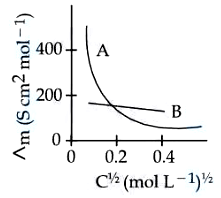
Curve B is a straight line with a small negative slope. This behaviour is characteristic of a strong electrolyte.
Strong electrolytes dissociate completely at all concentrations. The slight decrease in molar conductivity with increasing concentration is due to inter-ionic attractions (as described by the Debye-Hückel-Onsager equation).
Examples: KCl, NaCl, HCl.
Based on the graph of molar conductivity (Λm) versus the square root of concentration (C1/2), we can identify the nature of electrolytes A and B by looking at how they behave as they approach infinite dilution (C→0).
Curve A shows a steep, non-linear increase in molar conductivity as the concentration approaches zero. This is characteristic of a weak electrolyte.Weak electrolytes do not dissociate completely. As the solution is diluted, the degree of dissociation increases rapidly (Ostwald’s Dilution Law), leading to a sharp spike in the number of ions available to carry current.
Examples: CH3COOH (Acetic acid), NH4OH.
Was this solution helpful?
Click on the Email ☝️ to Watch the Video Solution
Create a FREE account and get:
_1.webp)

Educational materials for JEE preparation

Ask our AI anything

AI can make mistakes. Please verify important information.
AI can make mistakes. Please verify important information.
