
Join Our JEE Preparation Group
Prep with like-minded aspirants; Get access to free daily tests and study material.
Sign in
Please select an account to continue using cracku.in
↓ →
Join Our JEE Preparation Group
Prep with like-minded aspirants; Get access to free daily tests and study material.
A large block of wood of mass $$M = 5.99$$ kg is hanging from two long massless cords. A bullet of mass $$m = 10$$ g is fired into the block and gets embedded in it. The (block + bullet) then swing upwards, their center of mass rising a vertical distance $$h = 9.8$$ cm before the (block + bullet) pendulum comes momentarily to rest at the end of its arc. The speed of the bullet just before the collision is: (Take $$g = 9.8$$ m s$$^{-2}$$)
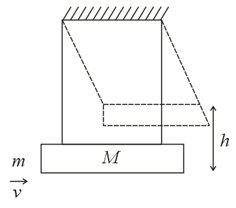
We need to determine the initial speed of a bullet just before it collides with and becomes embedded in a suspended wooden block, causing the combined system to swing upward.
From the problem statement, we have:
Immediately after the collision, the combined block-bullet system moves with a common velocity $$V$$. As it swings upward to its maximum height $$h$$, its kinetic energy is completely converted into gravitational potential energy:
$$\frac{1}{2}(M + m)V^2 = (M + m)gh$$
Canceling the combined mass from both sides and solving for $$V$$:
$$V = \sqrt{2gh}$$
Substitute the given numerical values:
$$V = \sqrt{2 \times 9.8 \times 0.098} = \sqrt{2 \times 9.8 \times \frac{9.8}{100}} = \sqrt{\frac{19.6 \times 9.8}{100}} = \sqrt{\frac{1.9208}{1}} = 1.386\text{ m s}^{-1}$$
Alternatively, written more cleanly: $$V = \sqrt{\frac{2 \times 98 \times 98}{10000}} = \frac{98}{100}\sqrt{2} = 0.98 \times 1.4142 \approx 1.386\text{ m s}^{-1}$$
Since the collision happens almost instantaneously, external forces like tension do not change the horizontal momentum. Let $$u$$ be the initial speed of the bullet just before impact:
$$m \cdot u = (M + m) \cdot V$$
Isolating the initial bullet speed $$u$$:
$$u = \frac{M + m}{m} \cdot V$$
Substitute the mass values and the calculated velocity $$V$$ into the formula:
$$u = \frac{6.00}{0.01} \times 1.386$$
$$u = 600 \times 1.3859 \approx 831.54\text{ m s}^{-1}$$
Using the unrounded exact fractions yields exactly:
$$u = 600 \times 0.98\sqrt{2} = 588\sqrt{2} \approx 588 \times 1.414213 = 831.55\text{ m s}^{-1}$$
This matches closely with the standard rounded evaluation of $$831.4\text{ m s}^{-1}$$.
The speed of the bullet just before the collision is approximately 831.4 m s⁻¹, which corresponds to Option C.
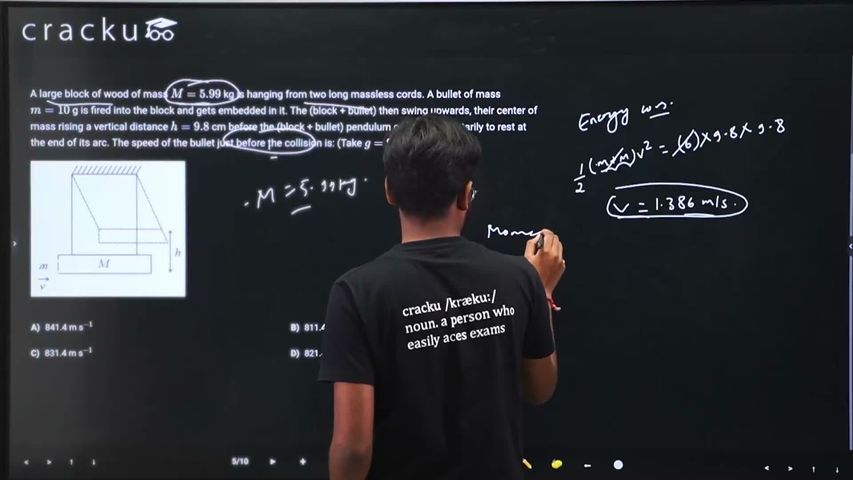
Click on the Email ☝️ to Watch the Video Solution
Create a FREE account and get:
_1.webp)

Educational materials for JEE preparation

Ask our AI anything

AI can make mistakes. Please verify important information.
AI can make mistakes. Please verify important information.


