Solution & Explanation
Question: The strongest acid from the following is:
- (A) p-chlorophenol
- (B) p-methylphenol (p-cresol)
- (C) Phenol
- (D) p-nitrophenol
π‘ Core Concept: How Acidic Strength Works in Phenols
An acid is stronger if it can easily lose a hydrogen ion (H+) and form a stable negative ion (phenoxide ion).
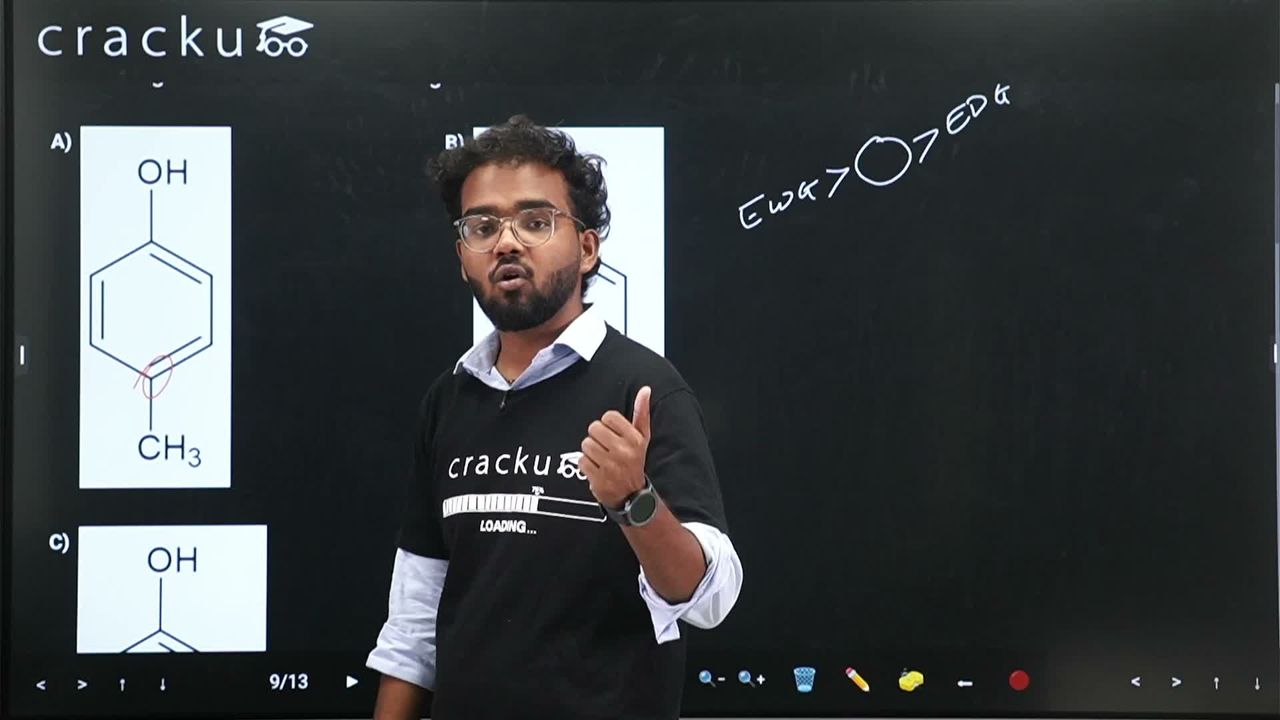
- Electron-Withdrawing Groups (EWGs): Pull electron density away from the oxygen atom, stabilizing the negative charge. This increases acidity.
- Electron-Donating Groups (EDGs): Push electron density toward the oxygen atom, destabilizing the negative charge. This decreases acidity.
Step-by-Step Analysis of the Options:
-
p-nitrophenol: Contains a nitro group (-NO2).
The -NO2 group is a Strong EWG due to both its powerful resonance (-M) and inductive (-I) effects. It strongly pulls electron density away from the ring, making it the most stable phenoxide ion.
-
p-chlorophenol: Contains a chlorine atom (-Cl).
Chlorine is a Weak EWG. While its inductive effect (-I) withdraws electrons, its resonance effect (+M) donates some electrons back, making it significantly less acidic than the nitro-substituted version.
-
Phenol: Has no substituents on the benzene ring, representing the standard baseline reference point.
-
p-methylphenol: Contains a methyl group (-CH3).
The methyl group is an EDG due to hyperconjugation and inductive effect (+I). It destabilizes the negative charge, making this molecule the least acidic of all.
Summary of Acidic Strength Order:
p-nitrophenol > p-chlorophenol > Phenol > p-methylphenol
Correct Answer: (D) p-nitrophenol