Join Our JEE Preparation Group
Prep with like-minded aspirants; Get access to free daily tests and study material.
Sign in
Please select an account to continue using cracku.in
↓ →
Join Our JEE Preparation Group
Prep with like-minded aspirants; Get access to free daily tests and study material.
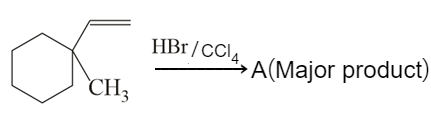
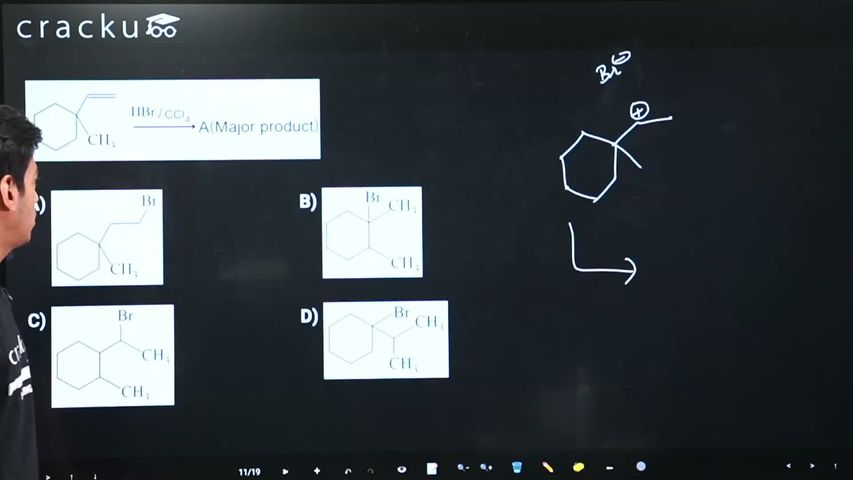
The reaction involves electrophilic addition of:
$$\mathrm{HBr/CCl_4}$$
to the alkene:
$$\mathrm{1\text{-}methyl\text{-}1\text{-}vinylcyclohexane}$$
The reaction follows Markovnikov addition and proceeds through a carbocation intermediate.
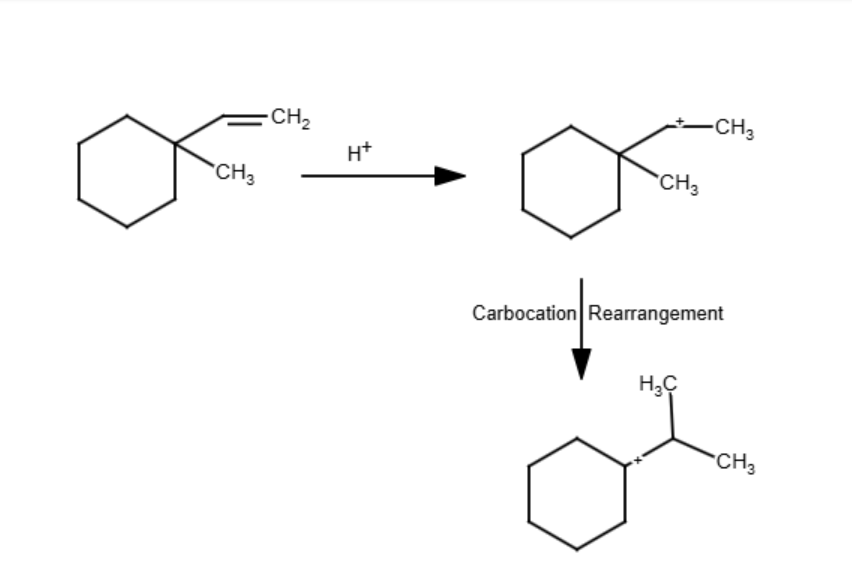
First, protonation of the double bond occurs.
According to Markovnikov’s rule, the proton adds to the terminal carbon:
$$\mathrm{=CH_2}$$
forming the more stable secondary carbocation.
$$\mathrm{-CH=CH_2 \longrightarrow -C^+H-CH_3}$$
This secondary carbocation lies adjacent to a quaternary carbon of the cyclohexane ring.
To form a more stable carbocation, a:
$$\mathrm{1,2\text{-}methyl\ shift}$$
takes place.
The methyl group migrates from the ring carbon to the carbocation centre.
This produces a highly stable tertiary carbocation on the ring carbon.
Simultaneously, the side chain becomes:
$$\mathrm{-CH(CH_3)_2}$$
(isopropyl group).
Ring expansion is less favoured because converting a six-membered ring into a seven-membered ring increases ring strain.
Finally, the bromide ion attacks the tertiary carbocation.
$$\mathrm{C^+ + Br^- \longrightarrow C-Br}$$
Thus, the major product formed is:
$$\mathrm{1\text{-}bromo\text{-}1\text{-}isopropylcyclohexane}$$
Was this solution helpful?
Click on the Email ☝️ to Watch the Video Solution
Create a FREE account and get:
_1.webp)

Educational materials for JEE preparation

Ask our AI anything

AI can make mistakes. Please verify important information.
AI can make mistakes. Please verify important information.