
Join Our JEE Preparation Group
Prep with like-minded aspirants; Get access to free daily tests and study material.
Sign in
Please select an account to continue using cracku.in
↓ →
Join Our JEE Preparation Group
Prep with like-minded aspirants; Get access to free daily tests and study material.
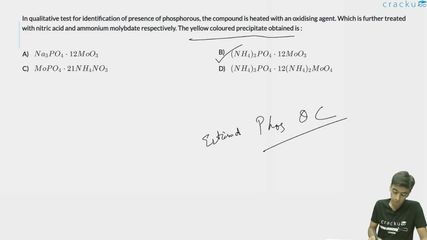
In qualitative test for identification of presence of phosphorous, the compound is heated with an oxidising agent. Which is further treated with nitric acid and ammonium molybdate respectively. The yellow coloured precipitate obtained is :
We need to identify the yellow coloured precipitate formed in the qualitative test for phosphorus.
Describe the test procedure
In the qualitative detection of phosphorus in organic compounds:
1. The organic compound is first heated with an oxidising agent (such as sodium peroxide or concentrated nitric acid) to convert all the phosphorus into phosphate ions ($$PO_4^{3-}$$).
2. The resulting solution is treated with concentrated nitric acid ($$HNO_3$$) to ensure an acidic medium.
3. Ammonium molybdate $$(NH_4)_2MoO_4$$ solution is then added.
Identify the product
The phosphate ions react with ammonium molybdate in the presence of nitric acid to form a characteristic canary yellow precipitate of ammonium phosphomolybdate:
$$PO_4^{3-} + 12(NH_4)_2MoO_4 + 21HNO_3 \rightarrow (NH_4)_3PO_4 \cdot 12MoO_3 \downarrow + 21NH_4NO_3 + 12H_2O$$
The yellow precipitate has the formula $$(NH_4)_3PO_4 \cdot 12MoO_3$$ (ammonium phosphomolybdate). This is a standard confirmatory test for the presence of phosphate ions.
The correct answer is Option (2): $$(NH_4)_3PO_4 \cdot 12MoO_3$$.
Was this solution helpful?
Click on the Email ☝️ to Watch the Video Solution
Create a FREE account and get:
_1.webp)

Educational materials for JEE preparation

Ask our AI anything

AI can make mistakes. Please verify important information.
AI can make mistakes. Please verify important information.
