
Join Our JEE Preparation Group
Prep with like-minded aspirants; Get access to free daily tests and study material.
Sign in
Please select an account to continue using cracku.in
↓ →
Join Our JEE Preparation Group
Prep with like-minded aspirants; Get access to free daily tests and study material.
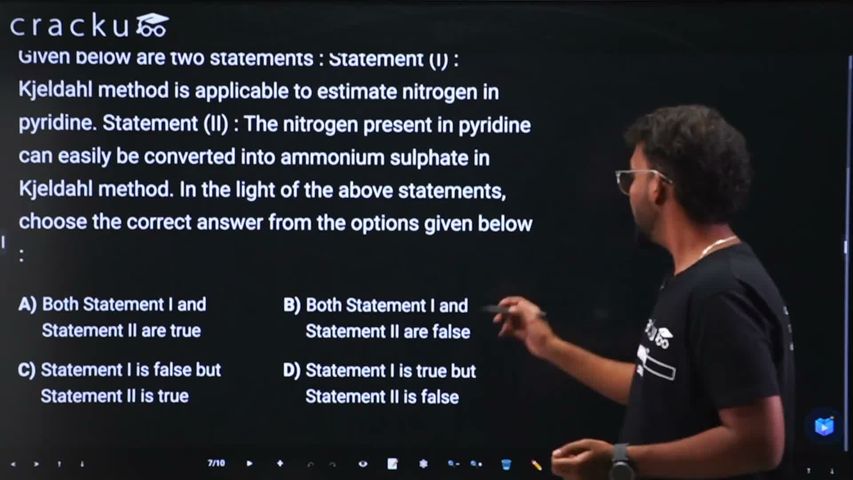
Given below are two statements : Statement (I) : Kjeldahl method is applicable to estimate nitrogen in pyridine. Statement (II) : The nitrogen present in pyridine can easily be converted into ammonium sulphate in Kjeldahl method. In the light of the above statements, choose the correct answer from the options given below :
We need to evaluate two statements about the Kjeldahl method and its applicability to pyridine.
Analysis of Statement (I): "Kjeldahl method is applicable to estimate nitrogen in pyridine."
This statement is FALSE. The Kjeldahl method is NOT applicable to compounds where nitrogen is present in a ring structure (as in pyridine, quinoline, and similar heterocyclic compounds), or in nitro groups ($$-NO_2$$) and azo groups ($$-N=N-$$). This is because the nitrogen in these structures is particularly resistant to being converted to ammonium sulphate by digestion with concentrated sulphuric acid.
Analysis of Statement (II): "The nitrogen present in pyridine can easily be converted into ammonium sulphate in Kjeldahl method."
This statement is also FALSE. The nitrogen in pyridine's ring structure cannot be easily liberated and converted to ammonium sulphate $$(NH_4)_2SO_4$$ during the digestion step of the Kjeldahl method. In the Kjeldahl method, the organic compound is digested with concentrated $$H_2SO_4$$ in the presence of a catalyst (such as $$K_2SO_4$$ and $$CuSO_4$$), which converts organic nitrogen to $$(NH_4)_2SO_4$$. However, the nitrogen locked in the aromatic ring of pyridine resists this conversion because of the extra stability of the aromatic ring.
Since both statements are false, the correct answer is Option (2): Both Statement I and Statement II are false.
Was this solution helpful?
Click on the Email ☝️ to Watch the Video Solution
Create a FREE account and get:
_1.webp)

Educational materials for JEE preparation

Ask our AI anything

AI can make mistakes. Please verify important information.
AI can make mistakes. Please verify important information.
