
Join Our JEE Preparation Group
Prep with like-minded aspirants; Get access to free daily tests and study material.
Sign in
Please select an account to continue using cracku.in
↓ →
Join Our JEE Preparation Group
Prep with like-minded aspirants; Get access to free daily tests and study material.
Arrange the following compounds in increasing order of rate of aromatic electrophilic substitution reaction.
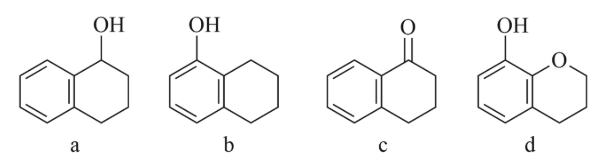
Electrophilic substitution reactions are faster when the aromatic ring is more electron-rich.
Let us analyze each compound.
For compound $$c$$:
$$\text{Tetralone}$$
The carbonyl group $$>C=O$$ shows both $$-I$$ and $$-M$$ effects and withdraws electron density from the aromatic ring.
Hence it is the least reactive towards electrophilic substitution.
For compound $$a$$:
The $$OH$$ group is present in the saturated ring and is not directly attached to the aromatic ring.
Therefore it cannot donate electrons to the benzene ring by resonance.
Its activating effect is very small.
For compound $$b$$:
The $$OH$$ group is directly attached to the aromatic ring. $$-OH$$ shows a strong $$+M$$ effect and activates the ring.
Hence $$b$$ is more reactive than $$a$$.
For compound $$d$$:
The $$OH$$ group is directly attached to the aromatic ring and can donate electrons by resonance.
In addition, the adjacent oxygen atom in the fused heterocyclic ring also donates electron density through resonance.
Thus the aromatic ring is most electron-rich in $$d$$.
Hence $$d$$ undergoes electrophilic substitution fastest.
Therefore, the increasing order of rate of aromatic electrophilic substitution is: $${c < a < b < d}$$
Was this solution helpful?
Create a FREE account and get:
_1.webp)

Educational materials for JEE preparation

Ask our AI anything

AI can make mistakes. Please verify important information.
AI can make mistakes. Please verify important information.
