
Join Our JEE Preparation Group
Prep with like-minded aspirants; Get access to free daily tests and study material.
Sign in
Please select an account to continue using cracku.in
↓ →
Join Our JEE Preparation Group
Prep with like-minded aspirants; Get access to free daily tests and study material.
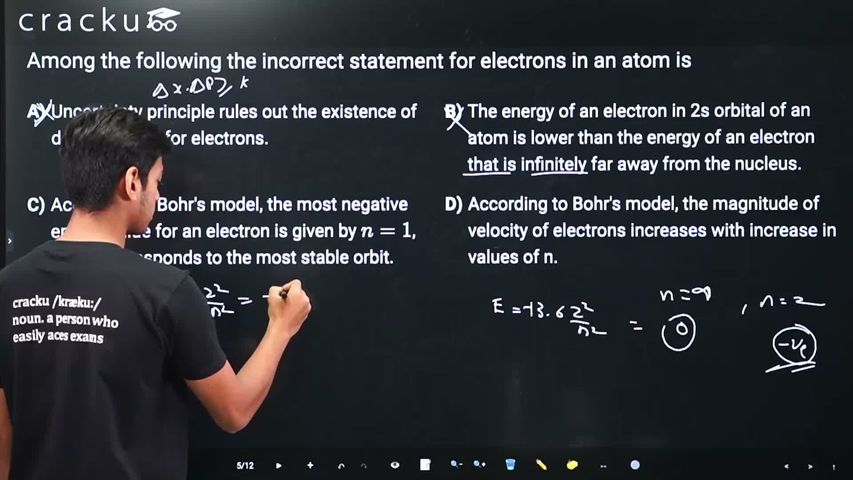
Among the following the incorrect statement for electrons in an atom is
The question asks which statements about the behaviour of electrons in an atom are correct. We examine each option one by one, quoting the pertinent theoretical result before judging the statement.
Option A
Heisenberg’s Uncertainty Principle states $$\Delta x \,\Delta p \,\ge \,\frac{h}{4\pi}$$. Because the position $$x$$ and linear momentum $$p$$ of an electron cannot be known simultaneously with arbitrary accuracy, it is impossible to trace out a precise trajectory (definite path) for the electron as one does for macroscopic particles. Therefore the existence of well-defined orbits is ruled out.
Hence, Option A is correct.
Option B
In quantum‐mechanical (or even Bohr) treatment, the reference level of energy is taken to be zero for an electron at an infinite distance from the nucleus. Any electron bound to the nucleus has an energy that is negative (lower than zero). A 2s electron is certainly bound, so $$E_{2s} \lt 0$$, whereas $$E_{\infty}=0$$. Thus the energy of an electron in the 2s orbital is lower than that of an electron infinitely far away.
Hence, Option B is correct.
Option C
Bohr derived the energy of the electron in a hydrogenic atom as
$$E_n = -\frac{13.6\,\text{eV}\,Z^{2}}{n^{2}}$$.
Because the expression is inversely proportional to $$n^{2}$$ and carries a negative sign, the most negative (lowest) energy occurs at the smallest possible principal quantum number, $$n = 1$$. Lower (more negative) energy means greater stability, so the $$n = 1$$ orbit is the most stable.
Hence, Option C is correct.
Option D
Bohr also obtained the speed of the electron in the $$n^{\text{th}}$$ orbit:
$$v_n = \frac{2.18\times10^{6}\,\text{m s}^{-1}}{n}\;Z$$.
For a fixed nucleus ($$Z$$ constant), $$v_n$$ is inversely proportional to $$n$$, i.e. as $$n$$ increases, the magnitude of velocity decreases. The statement that velocity increases with $$n$$ is therefore wrong.
Hence, Option D is incorrect.
Was this solution helpful?
Click on the Email ☝️ to Watch the Video Solution
Create a FREE account and get:
_1.webp)

Educational materials for JEE preparation

Ask our AI anything

AI can make mistakes. Please verify important information.
AI can make mistakes. Please verify important information.
