Join Our JEE Preparation Group
Prep with like-minded aspirants; Get access to free daily tests and study material.
Sign in
Please select an account to continue using cracku.in
↓ →
Join Our JEE Preparation Group
Prep with like-minded aspirants; Get access to free daily tests and study material.
Step 1: Protonation and Formation of the Carbocation
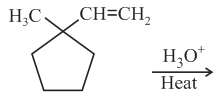
The starting material is a cyclopentane ring with a tertiary alcohol substituent group (specifically containing two methyl groups at the alpha position, as derived from the structures). Protonation of the hydroxyl group ($$\text{-OH}$$) by the acid turns it into an excellent leaving group ($$\text{-OH}_2^+$$). Water is eliminated, leaving behind a secondary carbocation outside the ring.
Step 2: Wagner-Meerwein Ring Expansion
The initial carbocation is adjacent to a strained five-membered cyclopentane ring. To relieve angle strain and form a more stable ring, a 1,2-alkyl shift occurs where one of the C-C bonds of the cyclopentane ring breaks and migrates to the carbocation carbon. This expands the five-membered ring into a much more stable six-membered cyclohexyl carbocation ring system.
Step 3: Deprotonation to Form the Most Stable Alkene
Finally, a water molecule acts as a weak base and removes a proton ($$\text{H}^+$$) from the adjacent carbon atom to establish a double bond. Following Zaitsev's Rule, elimination happens to yield the most highly substituted, conjugated, and thermodynamically stable tetrasubstituted alkene possible.
The ring expansion transforms the cyclopentane framework into a cyclohexane ring containing a double bond between two carbons that both bear a methyl group. This corresponds to 1,2-dimethylcyclohexene, which is illustrated as the correct option in Option B.
Answer: Option B
Create a FREE account and get:
_1.webp)

Educational materials for JEE preparation

Ask our AI anything

AI can make mistakes. Please verify important information.
AI can make mistakes. Please verify important information.