
Join Our JEE Preparation Group
Prep with like-minded aspirants; Get access to free daily tests and study material.
Sign in
Please select an account to continue using cracku.in
↓ →
Join Our JEE Preparation Group
Prep with like-minded aspirants; Get access to free daily tests and study material.
Given:
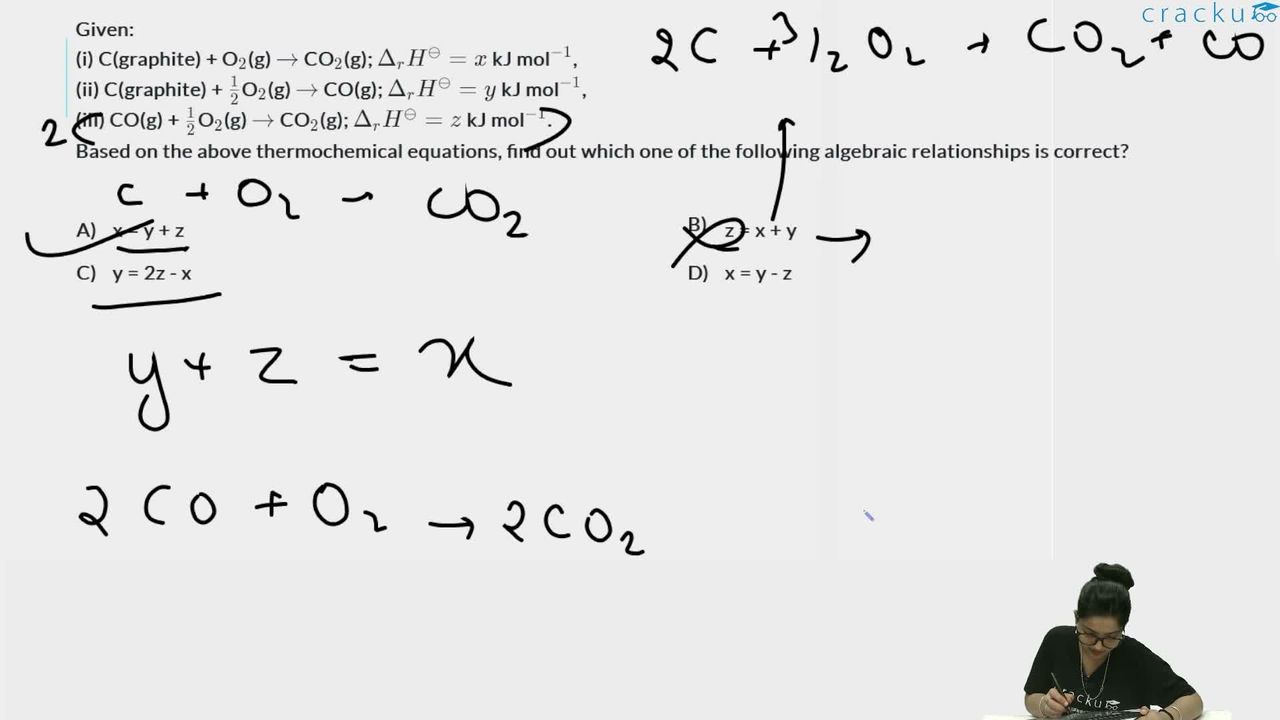
(i) C(graphite) + O$$_2$$(g) $$\to$$ CO$$_2$$(g); $$\Delta_r H^{\ominus} = x$$ kJ mol$$^{-1}$$,
(ii) C(graphite) + $$\frac{1}{2}$$O$$_2$$(g) $$\to$$ CO(g); $$\Delta_r H^{\ominus} = y$$ kJ mol$$^{-1}$$,
(iii) CO(g) + $$\frac{1}{2}$$O$$_2$$(g) $$\to$$ CO$$_2$$(g); $$\Delta_r H^{\ominus} = z$$ kJ mol$$^{-1}$$.
Based on the above thermochemical equations, find out which one of the following algebraic relationships is correct?
First, let us write the three given thermochemical equations together with their standard enthalpy changes.
$$\text{(i)}\qquad \mathrm{C(graphite)} + \mathrm{O_2}(g) \;\to\; \mathrm{CO_2}(g)\qquad \Delta_r H^\circ = x\;\text{kJ mol}^{-1}$$
$$\text{(ii)}\qquad \mathrm{C(graphite)} + \tfrac{1}{2}\mathrm{O_2}(g) \;\to\; \mathrm{CO}(g)\qquad \Delta_r H^\circ = y\;\text{kJ mol}^{-1}$$
$$\text{(iii)}\qquad \mathrm{CO}(g) + \tfrac{1}{2}\mathrm{O_2}(g) \;\to\; \mathrm{CO_2}(g)\qquad \Delta_r H^\circ = z\;\text{kJ mol}^{-1}$$
According to Hess’s Law, the standard enthalpy change for an overall reaction equals the algebraic sum of the standard enthalpy changes of the individual steps that yield the same net reaction. We will therefore add equations (ii) and (iii) algebraically and observe the result.
Adding the left-hand sides and the right-hand sides of (ii) and (iii) term by term, we obtain
$$\bigl[\mathrm{C(graphite)} + \tfrac{1}{2}\mathrm{O_2}(g)\bigr] + \bigl[\mathrm{CO}(g) + \tfrac{1}{2}\mathrm{O_2}(g)\bigr] \;\to\; \mathrm{CO}(g) + \mathrm{CO_2}(g).$$
Because one mole of $$\mathrm{CO}(g)$$ appears on both the reactant and the product sides, it cancels out, leaving
$$\mathrm{C(graphite)} + \mathrm{O_2}(g) \;\to\; \mathrm{CO_2}(g).$$
This net equation obtained from adding (ii) and (iii) is identical to equation (i). By Hess’s Law, the enthalpy change of this summed process is simply the sum of the enthalpy changes of the two individual steps:
$$\Delta_r H^\circ_{\text{(ii)}+\text{(iii)}} \;=\; y + z\;\text{kJ mol}^{-1}.$$
But equation (i) represents the same overall chemical change, and its enthalpy change is given as $$x\;\text{kJ mol}^{-1}$$. Therefore, we must have
$$x = y + z.$$
This exactly matches Option A.
Hence, the correct answer is Option A.
Was this solution helpful?
Click on the Email ☝️ to Watch the Video Solution
Create a FREE account and get:
_1.webp)

Educational materials for JEE preparation

Ask our AI anything

AI can make mistakes. Please verify important information.
AI can make mistakes. Please verify important information.


