Join Our JEE Preparation Group
Prep with like-minded aspirants; Get access to free daily tests and study material.
Sign in
Please select an account to continue using cracku.in
↓ →
Join Our JEE Preparation Group
Prep with like-minded aspirants; Get access to free daily tests and study material.
Reaction Analysis: Acid-Catalysed Dehydration
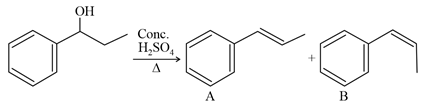
The reaction involves a secondary alcohol, $$\mathrm{1\text{-}phenylpropan\text{-}1\text{-}ol}$$, treated with concentrated sulfuric acid and heat.
$$\mathrm{1\text{-}Phenylpropan\text{-}1\text{-}ol \xrightarrow[\ \Delta\ ]{Conc.\ H_2SO_4} Alkene\ Products}$$
These conditions favour dehydration through an $$\mathrm{E1}$$ elimination mechanism.
Step 1: Protonation and Leaving Group Formation
The hydroxyl group gets protonated by the acid, converting it into a better leaving group.
$$\mathrm{Ph-CH(OH)-CH_2-CH_3 + H^+ \longrightarrow Ph-CH(OH_2^+)-CH_2-CH_3}$$
Step 2: Carbocation Formation
The protonated alcohol loses water to form a carbocation intermediate.
$$\mathrm{Ph-CH(OH_2^+)-CH_2-CH_3 \longrightarrow Ph-CH^+-CH_2-CH_3 + H_2O}$$
The carbocation formed is a benzylic carbocation.
This intermediate is highly stable because the positive charge is delocalised through resonance with the aromatic ring.
Step 3: Elimination (Zaitsev’s Rule)
A weak base such as $$\mathrm{H_2O}$$ or $$\mathrm{HSO_4^-}$$ removes a beta-hydrogen from the adjacent carbon.
Formation of the double bond gives an alkene conjugated with the benzene ring.
$$\mathrm{Ph-CH^+-CH_2-CH_3 \longrightarrow Ph-CH=CH-CH_3 + H^+}$$
Formation of Products $$\mathrm{A}$$ and $$\mathrm{B}$$
The newly formed double bond gives rise to geometrical isomers.
Product $$\mathrm{A}$$ (Trans-Isomer):
In this isomer, the phenyl group and methyl group are present on opposite sides of the double bond.
$$\mathrm{trans\text{-}Ph-CH=CH-CH_3}$$
Product $$\mathrm{B}$$ (Cis-Isomer):
In this isomer, the phenyl group and methyl group are present on the same side of the double bond.
$$\mathrm{cis\text{-}Ph-CH=CH-CH_3}$$
Conclusion:
The trans-isomer is more stable because bulky groups remain farther apart, reducing steric hindrance.
The cis-isomer experiences greater steric repulsion because the phenyl and methyl groups are on the same side.
Therefore:
$$\mathrm{Product\ A\ (trans\text{-}isomer)\ is\ the\ major\ product}$$
while
$$\mathrm{Product\ B\ (cis\text{-}isomer)\ is\ the\ minor\ product}$$
Correct Statement:
$$\mathrm{A\ is\ the\ major\ product\ (because\ the\ trans\text{-}alkene\ is\ more\ stable\ due\ to\ less\ steric\ hindrance)}$$
Was this solution helpful?
Create a FREE account and get:
_1.webp)

Educational materials for JEE preparation

Ask our AI anything

AI can make mistakes. Please verify important information.
AI can make mistakes. Please verify important information.