
Join Our JEE Preparation Group
Prep with like-minded aspirants; Get access to free daily tests and study material.
Sign in
Please select an account to continue using cracku.in
↓ →
Join Our JEE Preparation Group
Prep with like-minded aspirants; Get access to free daily tests and study material.
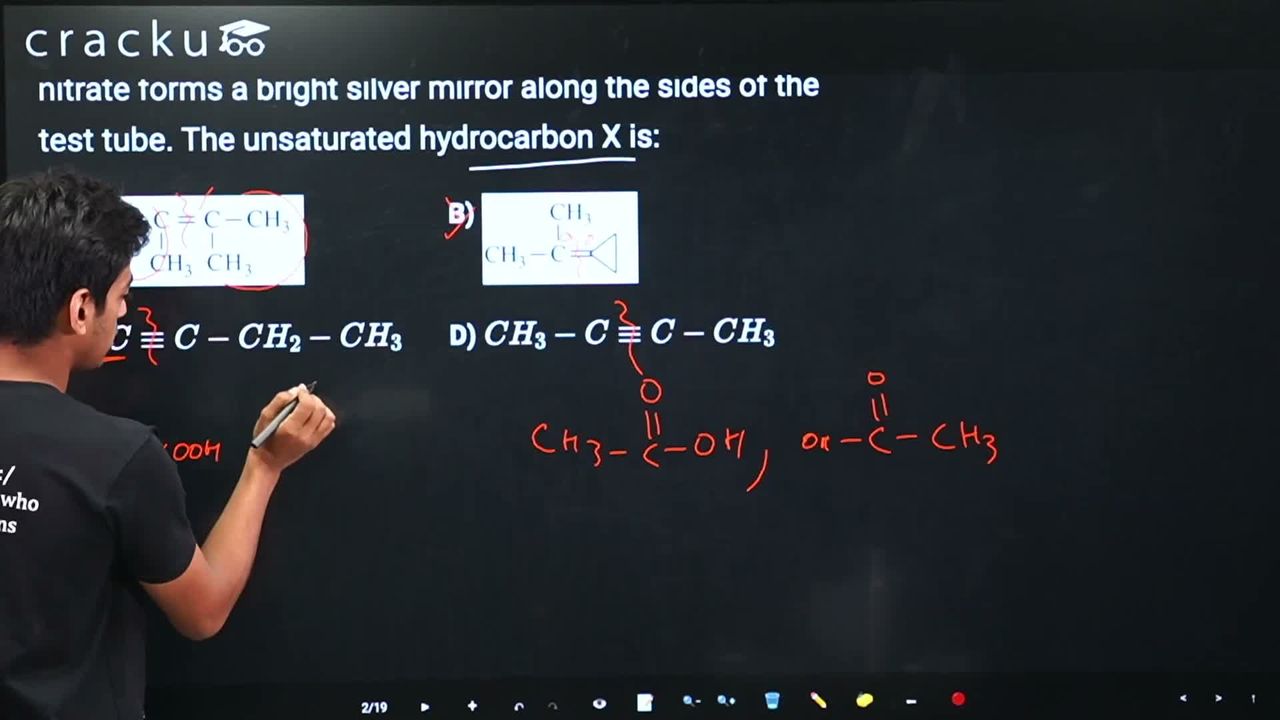
An unsaturated hydrocarbon X on ozonolysis gives A. Compound A when warmed with ammoniacal silver nitrate forms a bright silver mirror along the sides of the test tube. The unsaturated hydrocarbon X is:
The reaction requires identifying a hydrocarbon whose ozonolysis product gives a positive Tollens’ test.
Tollens’ reagent gives a positive test for aldehydes.
Among carboxylic acids, only $$\mathrm{HCOOH}$$ can also reduce Tollens’ reagent because it contains an aldehydic hydrogen.
For option $$\mathrm{(A)}$$, ozonolysis of $$\mathrm{2,3\text{-}Dimethyl\text{-}2\text{-}butene}$$ forms acetone, which is a ketone and does not respond to Tollens’ reagent.
For option $$\mathrm{(B)}$$, ozonolysis of isopropylidenecyclopropane forms acetone and cyclopropanone, both ketones, so Tollens’ test is negative.
For option $$\mathrm{(D)}$$, ozonolysis of $$\mathrm{2\text{-}Butyne}$$ forms acetic acid $$\mathrm{(CH_3COOH)}$$, which does not respond to Tollens’ reagent.
For option $$\mathrm{(C)}$$, ozonolysis of $$\mathrm{1\text{-}Butyne\ (HC\equiv C-CH_2-CH_3)}$$ produces propanoic acid and:
$$\mathrm{HCOOH}$$
Formic acid gives a positive Tollens’ test and forms the silver mirror.
Thus, compound $$\mathrm{A}$$ is:
$$\mathrm{HCOOH}$$
Thus, the correct option is C.
Was this solution helpful?
Click on the Email ☝️ to Watch the Video Solution
Create a FREE account and get:
_1.webp)

Educational materials for JEE preparation

Ask our AI anything

AI can make mistakes. Please verify important information.
AI can make mistakes. Please verify important information.
