
Join Our JEE Preparation Group
Prep with like-minded aspirants; Get access to free daily tests and study material.
Sign in
Please select an account to continue using cracku.in
↓ →
Join Our JEE Preparation Group
Prep with like-minded aspirants; Get access to free daily tests and study material.
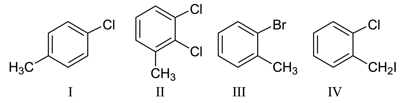
Among the following compounds I - IV, which one forms a yellow precipitate on reacting sequentially with
(i) NaOH (ii) dil. HNO$$_3$$ (iii) AgNO$$_3$$
To determine which compound forms a yellow precipitate under the given conditions, we need to understand the role of each reagent and the reactivity of the different carbon-halogen bonds present in the compounds.
The first reagent is $$\mathrm{NaOH}$$.
Aqueous $$\mathrm{NaOH}$$ acts as a nucleophile and displaces reactive halogen atoms through nucleophilic substitution reactions, releasing halide ions into the solution.
The second reagent is dilute $$\mathrm{HNO_3}$$.
Its purpose is to neutralize the excess $$\mathrm{NaOH}$$ so that silver oxide does not form when silver nitrate is added.
The third reagent is $$\mathrm{AgNO_3}$$.
It reacts with the liberated halide ions to form insoluble silver halides.
The colours of the precipitates are:
Therefore, a yellow precipitate will be obtained only if iodide ions $$\left(\mathrm{I^-}\right)$$ are released into the solution.
Now let us examine the nature of the carbon-halogen bonds in the given compounds.
Halogens directly attached to a benzene ring are aryl halides. These are highly resistant to nucleophilic substitution because the carbon-halogen bond acquires partial double bond character through resonance.
On the other hand, alkyl and benzylic halides undergo nucleophilic substitution readily. Benzylic halides are particularly reactive because the intermediate formed during substitution is resonance stabilized.
Compound I contains chlorine attached directly to the benzene ring. It is an aryl halide and does not react with $$\mathrm{NaOH}$$.
Compound II contains two aryl chlorides. Neither of them undergoes substitution under these conditions.
Compound III contains bromine directly attached to the benzene ring. It is also an aryl halide and remains unreactive.
Compound IV contains both an aryl chlorine and a benzylic iodine atom.
The benzylic carbon undergoes nucleophilic substitution easily.
$$\mathrm{Ar{-}CH_2I + NaOH \rightarrow Ar{-}CH_2OH + NaI}$$
The iodide ions released then react with silver nitrate.
$$\mathrm{Ag^+ + I^- \rightarrow AgI,(yellow\ precipitate)}$$
Hence, Compound IV is the only compound that produces the characteristic yellow precipitate.
Therefore, the correct answer is Option (D) IV.
Was this solution helpful?
Create a FREE account and get:
_1.webp)

Educational materials for JEE preparation

Ask our AI anything

AI can make mistakes. Please verify important information.
AI can make mistakes. Please verify important information.
