
Join Our JEE Preparation Group
Prep with like-minded aspirants; Get access to free daily tests and study material.
Sign in
Please select an account to continue using cracku.in
↓ →
Join Our JEE Preparation Group
Prep with like-minded aspirants; Get access to free daily tests and study material.
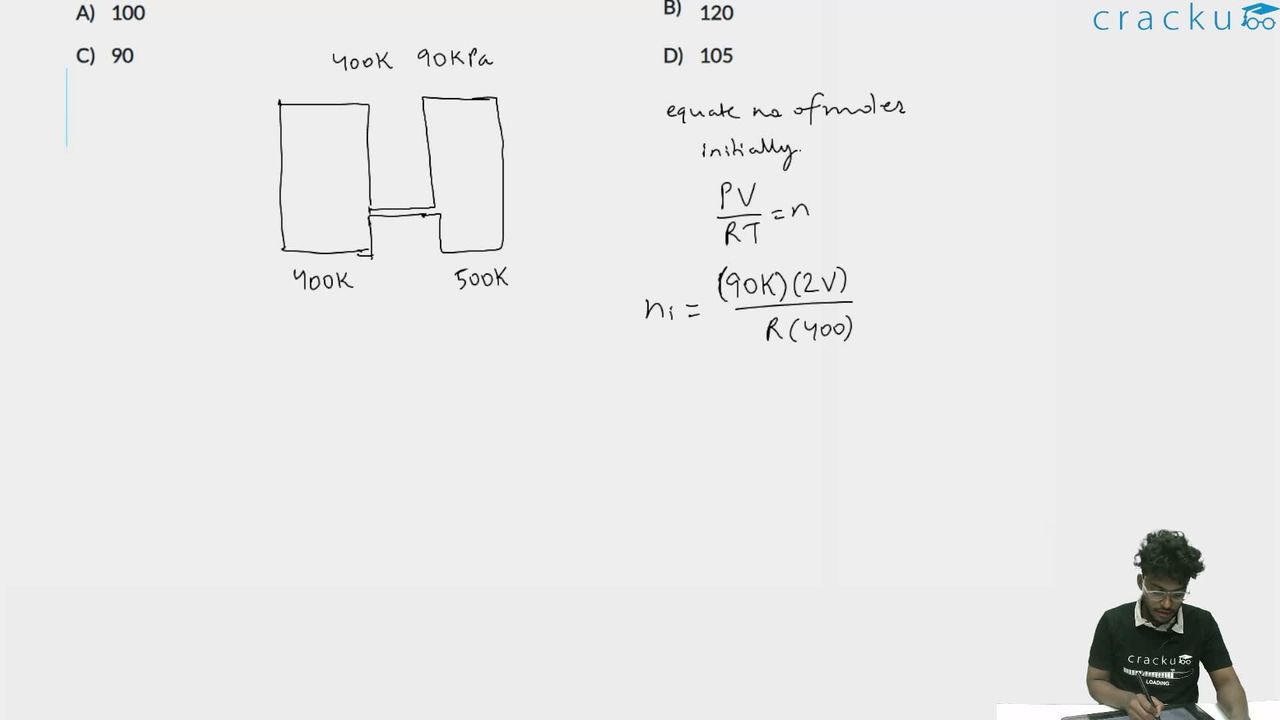
Two closed vessels of same volume are joined through a narrow tube and both vessels are filled with air of pressure 90 kPa and temperature 400 K. Keeping the temperature of one vessel constant at 400 K the second vessel temperature is raised to 500 K. The final pressure in the vessels is _______ kPa.
Initial pressure, $$P_i = 90\text{ kPa}$$
Initial temperature of vessel 1, $$T_1 = 400\text{ K}$$
Initial temperature of vessel 2, $$T_2 = 400\text{ K}$$
Final pressure, $$P_f = \text{?}$$
Final temperature of vessel 1, $$T_1' = 400\text{ K}$$
Final temperature of vessel 2, $$T_2' = 500\text{ K}$$
the total number of moles of air initially is equal to the total number of moles of air finally.
By the ideal gas law ($$PV = nRT$$), the number of moles $$n = \frac{PV}{RT}$$.
Conservation of moles:
$$ n_{initial} = n_{final} $$
$$ n_{1i} + n_{2i} = n_{1f} + n_{2f} $$
$$ \frac{P_i V}{R T_1} + \frac{P_i V}{R T_2} = \frac{P_f V}{R T_1'} + \frac{P_f V}{R T_2'} $$
$$ P_i \left( \frac{1}{T_1} + \frac{1}{T_2} \right) = P_f \left( \frac{1}{T_1'} + \frac{1}{T_2'} \right) $$
$$ 90 \left( \frac{1}{400} + \frac{1}{400} \right) = P_f \left( \frac{1}{400} + \frac{1}{500} \right) $$
$$ 90 \left( \frac{2}{400} \right) = P_f \left( \frac{5 + 4}{2000} \right) $$
$$ 90 \left( \frac{1}{200} \right) = P_f \left( \frac{9}{2000} \right) $$
$$ \frac{90}{200} = P_f \left( \frac{9}{2000} \right) $$
Solve for $$P_f$$:
$$ P_f = \frac{90}{200} \times \frac{2000}{9} $$
$$ P_f = \left(\frac{90}{9}\right) \times \left(\frac{2000}{200}\right) $$
$$ P_f = 10 \times 10 $$
$$ P_f = 100\text{ kPa} $$
Was this solution helpful?
Click on the Email ☝️ to Watch the Video Solution
Create a FREE account and get:
_1.webp)

Educational materials for JEE preparation

Ask our AI anything

AI can make mistakes. Please verify important information.
AI can make mistakes. Please verify important information.


