Join Our JEE Preparation Group
Prep with like-minded aspirants; Get access to free daily tests and study material.
Sign in
Please select an account to continue using cracku.in
↓ →
Join Our JEE Preparation Group
Prep with like-minded aspirants; Get access to free daily tests and study material.
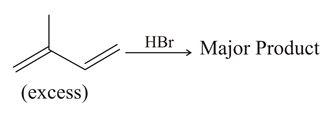
To determine the major product of this reaction, we need to analyze the electrophilic addition of hydrogen bromide $$\left(HBr\right)$$ to the conjugated diene, isoprene.
The word "excess" under the diene indicates that the diene is present in large excess relative to $$HBr$$. Therefore, only one equivalent of $$HBr$$ reacts with the diene, eliminating the possibility of double addition products. Hence, options A and D can be ruled out immediately.
The first step is protonation of the diene.
The proton adds to the terminal carbon of the methyl-substituted double bond because this generates the most stable intermediate, a tertiary allylic carbocation.
Adding the proton to the opposite end would produce only a secondary allylic carbocation, which is less stable.
The tertiary allylic carbocation formed is resonance stabilized. The positive charge is delocalized over two carbon atoms as shown below.
$$CH_3-\overset{+}{C}(CH_3)-CH=CH_2 \longleftrightarrow CH_3-C(CH_3)=CH-\overset{+}{CH_2}$$
The bromide ion can now attack either of these positively charged centers.
Attack at the tertiary carbon gives the 1,2-addition product, 3-bromo-3-methylbut-1-ene. This product forms rapidly because the tertiary carbon bears a greater share of the positive charge. However, the resulting alkene is only monosubstituted and is therefore less stable.
Attack at the terminal carbon gives the 1,4-addition product, 1-bromo-3-methylbut-2-ene. Although this product forms more slowly, it contains a trisubstituted internal double bond, making it thermodynamically more stable.
Under normal or higher temperature conditions, electrophilic addition to conjugated dienes is thermodynamically controlled. Therefore, the more stable 1,4-addition product is formed in greater amount.
Hence, the major product is 1-bromo-3-methylbut-2-ene, corresponding to Option (C).
Was this solution helpful?
Create a FREE account and get:
_1.webp)

Educational materials for JEE preparation

Ask our AI anything

AI can make mistakes. Please verify important information.
AI can make mistakes. Please verify important information.