
Join Our JEE Preparation Group
Prep with like-minded aspirants; Get access to free daily tests and study material.
Sign in
Please select an account to continue using cracku.in
↓ →
Join Our JEE Preparation Group
Prep with like-minded aspirants; Get access to free daily tests and study material.
An electron of mass $$m$$ is moving in an electric field $$\vec{E} = -2E_o \hat{i}$$ ($$E_o$$ = constant > 0), with an initial velocity $$\vec{V} = v_o \hat{i}$$ ($$v_o$$ = constant > 0). If $$\lambda_o = \frac{h}{4mv_o}$$, its de Broglie wavelength at time $$t$$ is _______. ($$e$$ = charge of electron)
Solution :
Electric field :
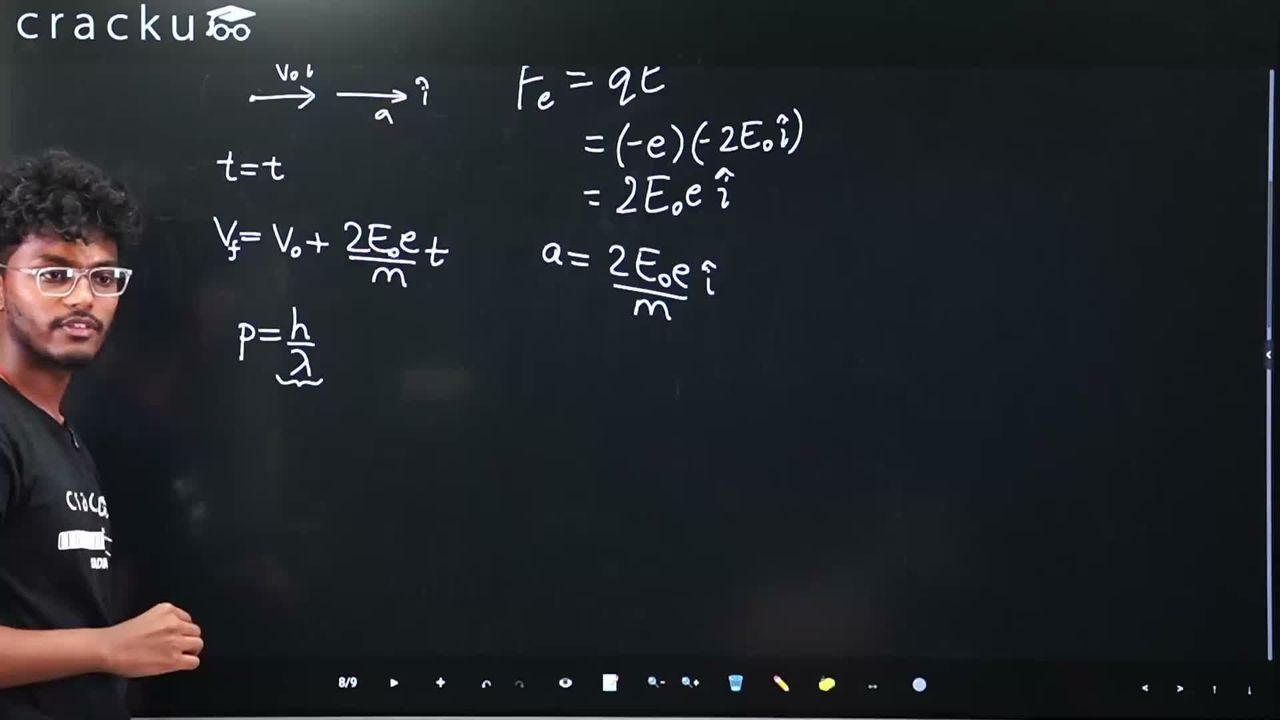
$$\vec E = -2E_0\hat i$$
Force on electron :
$$\vec F = q\vec E$$
Since charge of electron is :
$$q = -e$$
Therefore,
$$\vec F = (-e)(-2E_0\hat i)$$
$$= 2eE_0\hat i$$
Acceleration of electron :
$$a = \frac{F}{m}$$
$$= \frac{2eE_0}{m}$$
Velocity after time \(t\) :
$$v = v_0 + at$$
$$= v_0 + \frac{2eE_0t}{m}$$
de Broglie wavelength :
$$\lambda = \frac{h}{mv}$$
$$= \frac{h}{m\left(v_0+\frac{2eE_0t}{m}\right)}$$
$$= \frac{h}{mv_0+2eE_0t}$$
Given,
$$\lambda_0 = \frac{h}{4mv_0}$$
Therefore,
$$h = 4mv_0\lambda_0$$
Substituting :
$$\lambda=\frac{4mv_0\lambda_0}{mv_0+2eE_0t}$$
$$=\frac{4\lambda_0}{1+\frac{2eE_0t}{mv_0}}$$
Final Answer :
$$\lambda = \frac{4\lambda_0}{1+\frac{2eE_0t}{mv_0}}$$
Was this solution helpful?
Click on the Email ☝️ to Watch the Video Solution
Create a FREE account and get:
_1.webp)

Educational materials for JEE preparation

Ask our AI anything

AI can make mistakes. Please verify important information.
AI can make mistakes. Please verify important information.


