
Join Our JEE Preparation Group
Prep with like-minded aspirants; Get access to free daily tests and study material.
Sign in
Please select an account to continue using cracku.in
↓ →
Join Our JEE Preparation Group
Prep with like-minded aspirants; Get access to free daily tests and study material.
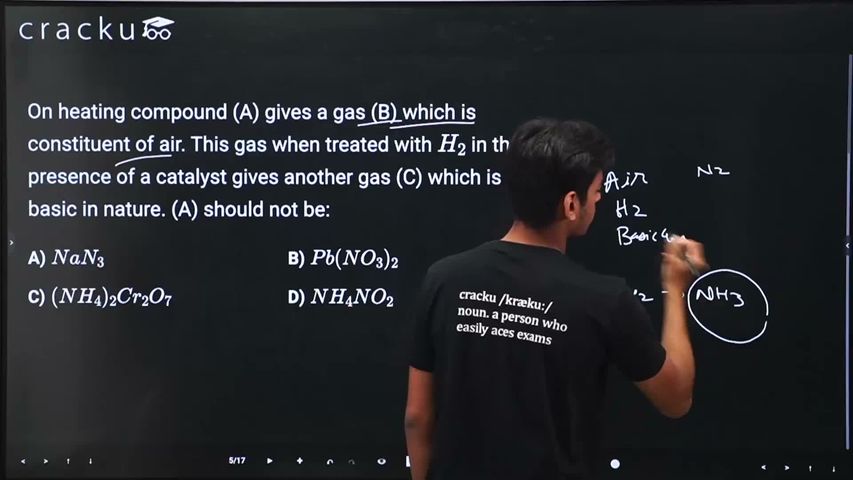
On heating compound (A) gives a gas (B) which is constituent of air. This gas when treated with $$H_2$$ in the presence of a catalyst gives another gas (C) which is basic in nature. (A) should not be:
We begin by interpreting the information given. Compound (A) is said to liberate a gas (B) when heated. Gas (B) is further described as “a constituent of air”. The principal constituents of air are $$N_2 \;( \text{about }78\% )$$ and $$O_2 \;( \text{about }21\% ).$$ The next statement tells us that when this gas (B) is treated with hydrogen in the presence of a catalyst, another gas (C) is obtained and that gas (C) is basic in nature.
Now we recall a well-known catalytic reaction involving one of the major air gases:
Stated formula (Haber-Bosch process): $$N_2 + 3H_2 \xrightarrow{\text{Fe catalyst, high }T,P} 2NH_3$$
Here the reactant gas $$N_2$$ comes from air, and the product $$NH_3$$ is a basic gas. Oxygen, on the other hand, reacts with hydrogen to form water $$ \bigl( O_2 + 2H_2 \to 2H_2O \bigr)$$ which is not a basic gas. Therefore, the only air constituent that satisfies the second condition is
$$\boxed{N_2 \;\text{(gas B)}}$$
Consequently gas (C) must be
$$\boxed{NH_3 \;\text{(basic gas)}}$$
Hence, compound (A) must be one that evolves $$N_2$$ on heating. Let us test every option by writing its thermal decomposition step by step:
Option A : $$NaN_3$$
On heating, sodium azide decomposes as
$$2NaN_3 \;\xrightarrow{\Delta}\; 2Na + 3N_2$$
Clearly, $$N_2$$ is produced.
Option B : $$Pb(NO_3)_2$$
Lead(II) nitrate decomposes as
$$2Pb(NO_3)_2 \;\xrightarrow{\Delta}\; 2PbO + 4NO_2 + O_2$$
The gaseous products are $$NO_2$$ and $$O_2$$, not $$N_2$$. Therefore this option does not give $$N_2$$.
Option C : $$(NH_4)_2Cr_2O_7$$
On heating, ammonium dichromate undergoes the well-known “volcano” decomposition:
$$(NH_4)_2Cr_2O_7 \;\xrightarrow{\Delta}\; Cr_2O_3 + N_2 + 4H_2O$$
Again, $$N_2$$ is evolved.
Option D : $$NH_4NO_2$$
Ammonium nitrite is thermally unstable and decomposes as
$$NH_4NO_2 \;\xrightarrow{\Delta}\; N_2 + 2H_2O$$
This also yields $$N_2$$.
From the above step-by-step analysis we see that every option except Option B produces $$N_2$$ on heating. Since compound (A) must evolve $$N_2$$, the compound that should not be chosen is the one that fails to do so, namely $$Pb(NO_3)_2$$.
Hence, the correct answer is Option 2.
Was this solution helpful?
Click on the Email ☝️ to Watch the Video Solution
Create a FREE account and get:
_1.webp)

Educational materials for JEE preparation

Ask our AI anything

AI can make mistakes. Please verify important information.
AI can make mistakes. Please verify important information.
