
Join Our JEE Preparation Group
Prep with like-minded aspirants; Get access to free daily tests and study material.
Sign in
Please select an account to continue using cracku.in
↓ →
Join Our JEE Preparation Group
Prep with like-minded aspirants; Get access to free daily tests and study material.
The metal mainly used in devising photoelectric cells is:
We recall that the basic requirement for a metal to be used in a photo-electric cell is that the metal must emit electrons even when illuminated by weak light of comparatively large wavelength. For this to happen, the metal should have a very small work function $$\phi$$ because the Einstein photoelectric equation, first of all, states
$$K_{\text{max}} \;=\; h\nu \;-\; \phi$$
where $$K_{\text{max}}$$ is the maximum kinetic energy of the emitted electrons, $$h$$ is Planck’s constant and $$\nu$$ is the frequency of the incident light. A smaller value of $$\phi$$ means that even low-energy (long-wavelength) photons can satisfy the condition $$h\nu \ge \phi$$ and eject electrons.
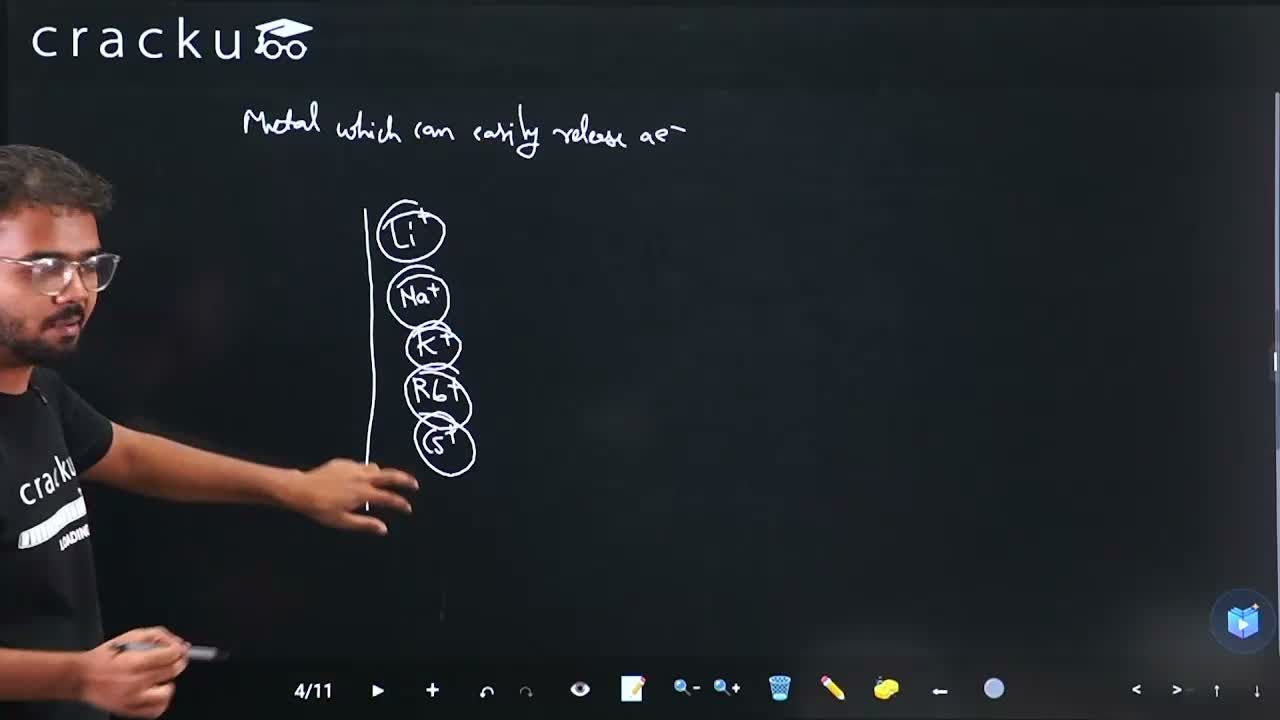
Among all common metals, the alkali metals are well known for having the least values of work function because their outermost electron is loosely bound. Within the alkali-metal family the work functions follow the general trend
$$\phi_{\text{Na}} \; > \; \phi_{\text{Li}} \; > \; \phi_{\text{Rb}} \; > \; \phi_{\text{Cs}}$$
That is, cesium (Cs) possesses the minimum work function of all the listed metals. This minimal work function ensures the greatest ease of photo-electron emission, which is why cesium is chosen almost universally for constructing photoelectric cells.
Now we match this result with the options given in the question. Option D corresponds to Cs. Since Cs provides the optimal low work function required for the device, it is the metal mainly used in devising photoelectric cells.
Hence, the correct answer is Option D.
Was this solution helpful?
Click on the Email ☝️ to Watch the Video Solution
Create a FREE account and get:
_1.webp)

Educational materials for JEE preparation

Ask our AI anything

AI can make mistakes. Please verify important information.
AI can make mistakes. Please verify important information.
