
Join Our JEE Preparation Group
Prep with like-minded aspirants; Get access to free daily tests and study material.
Sign in
Please select an account to continue using cracku.in
↓ →
Join Our JEE Preparation Group
Prep with like-minded aspirants; Get access to free daily tests and study material.
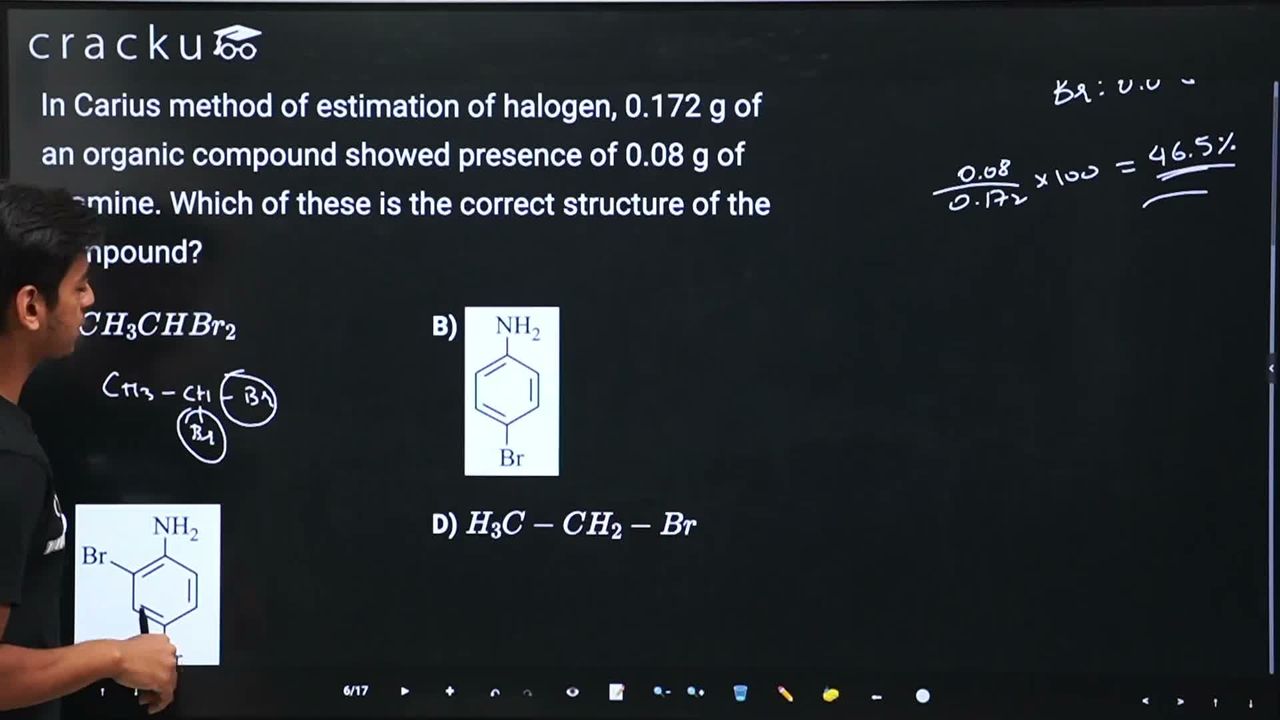
In Carius method of estimation of halogen, 0.172 g of an organic compound showed presence of 0.08 g of bromine. Which of these is the correct structure of the compound?
In the Carius method we directly obtain the mass of halogen present. Here,
$$\text{Mass of compound taken}=0.172\ \text{g}$$
$$\text{Mass of bromine found}=0.080\ \text{g}$$
We first calculate the percentage of bromine in the unknown sample. The general relation is
$$\%\,\text{Br}=\frac{\text{mass of Br obtained}}{\text{mass of sample}}\times 100$$
Substituting the given numbers,
$$\%\,\text{Br}=\frac{0.080}{0.172}\times 100$$
$$\%\,\text{Br}=0.465116\ldots\times 100$$
$$\%\,\text{Br}=46.5116\% \approx 46.5\%$$
Now we compare this experimental value with the theoretical bromine percentages of each option. For every structure we first write its molecular formula, then its molar mass, and finally the percentage of bromine.
Option A : $$CH_3CHBr_2$$
Molecular formula: $$C_2H_4Br_2$$
Molar mass:
$$M=2(12)+4(1)+2(79.9)=24+4+159.8=187.8\ \text{g mol}^{-1}$$
Theoretical bromine percentage:
$$\%\,\text{Br}=\frac{2(79.9)}{187.8}\times 100=\frac{159.8}{187.8}\times 100=85.06\%$$
This is far higher than the required $$46.5\%$$, so Option A is rejected.
Option B : p-bromoaniline
Molecular formula: an aniline ring $$C_6H_5NH_2$$ with one Br substituent gives $$C_6H_6BrN$$.
Molar mass:
$$M=6(12)+6(1)+79.9+14=72+6+79.9+14=171.9\ \text{g mol}^{-1}$$
Theoretical bromine percentage:
$$\%\,\text{Br}=\frac{79.9}{171.9}\times 100=46.509\%\approx 46.5\%$$
This matches the experimental value almost exactly.
Option C : 3,5-dibromoaniline
Molecular formula: $$C_6H_5Br_2N$$
Molar mass:
$$M=6(12)+5(1)+2(79.9)+14=72+5+159.8+14=250.8\ \text{g mol}^{-1}$$
Theoretical bromine percentage:
$$\%\,\text{Br}=\frac{159.8}{250.8}\times 100=63.74\%$$
This value is much higher than $$46.5\%$$, so Option C is also ruled out.
Option D : $$H_3CCH_2Br$$
Molecular formula: $$C_2H_5Br$$
Molar mass:
$$M=2(12)+5(1)+79.9=24+5+79.9=108.9\ \text{g mol}^{-1}$$
Theoretical bromine percentage:
$$\%\,\text{Br}=\frac{79.9}{108.9}\times 100=73.40\%$$
Again this is far above $$46.5\%$$, so Option D is discarded.
Only p-bromoaniline shows a bromine percentage that coincides with the experimental value. Therefore the unknown compound must be p-bromoaniline.
Hence, the correct answer is Option B.
Was this solution helpful?
Click on the Email ☝️ to Watch the Video Solution
Create a FREE account and get:
_1.webp)

Educational materials for JEE preparation

Ask our AI anything

AI can make mistakes. Please verify important information.
AI can make mistakes. Please verify important information.
