
Join Our JEE Preparation Group
Prep with like-minded aspirants; Get access to free daily tests and study material.
Sign in
Please select an account to continue using cracku.in
↓ →
Join Our JEE Preparation Group
Prep with like-minded aspirants; Get access to free daily tests and study material.
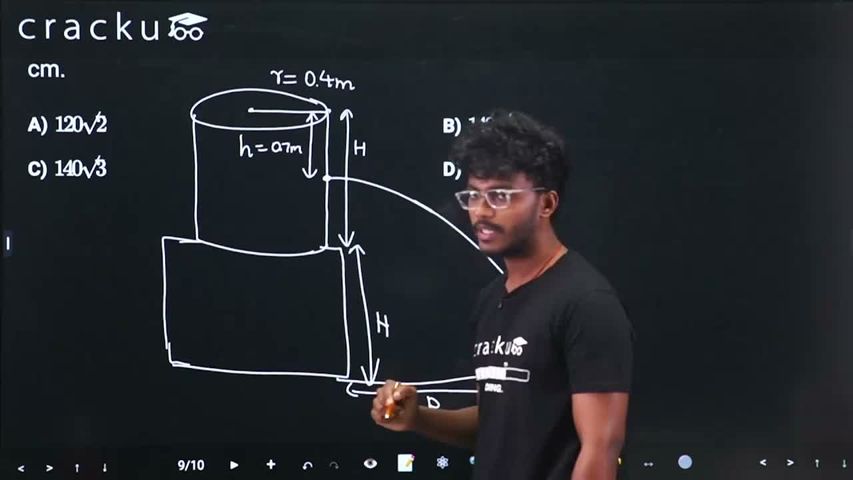
A cylindrical vessel of 40 cm radius is completely filled with water and its capacity is 528 dm$$^3$$ (dm : decimeter). The vessel is placed on a solid block of exactly same height as vessel. If a small hole is made at 70 cm below the top of water level, then horizontal range of water falling on the ground in the beginning is __________ cm.
The formula for the volume of a cylinder is $$V = \pi r^2 H$$:
$$528 = \frac{22}{7} \times 4^2 \times H$$
$$528 = \frac{22 \times 16}{7} \times H \implies 528 = \frac{352}{7} \times H$$
$$H = \frac{528 \times 7}{352} = 1.5 \times 7 = 10.5\text{ dm} = 105\text{ cm}$$
Depth of the hole from the top water level ($$h$$) = $$70\text{ cm}$$. The vessel is placed on a solid block of the exact same height as the vessel ($$H = 105\text{ cm}$$).
The height of the hole above the ground ($$H'$$) = $$\text{Height of block} + (\text{Height of vessel} - h)$$
$$H' = 105 + (105 - 70) = 105 + 35 = 140\text{ cm}$$
$$v = \sqrt{2gh}$$
$$t = \sqrt{\frac{2H'}{g}}$$
$$R = v \times t = \sqrt{2gh} \times \sqrt{\frac{2H'}{g}} = 2\sqrt{h \cdot H'}$$
$$R = 2\sqrt{70 \times 140} = 2\sqrt{9800} = 2 \times 70\sqrt{2} = 140\sqrt{2}\text{ cm}$$
Was this solution helpful?
Click on the Email ☝️ to Watch the Video Solution
Create a FREE account and get:
_1.webp)

Educational materials for JEE preparation

Ask our AI anything

AI can make mistakes. Please verify important information.
AI can make mistakes. Please verify important information.
