Join WhatsApp Icon JEE WhatsApp Group
Question 33

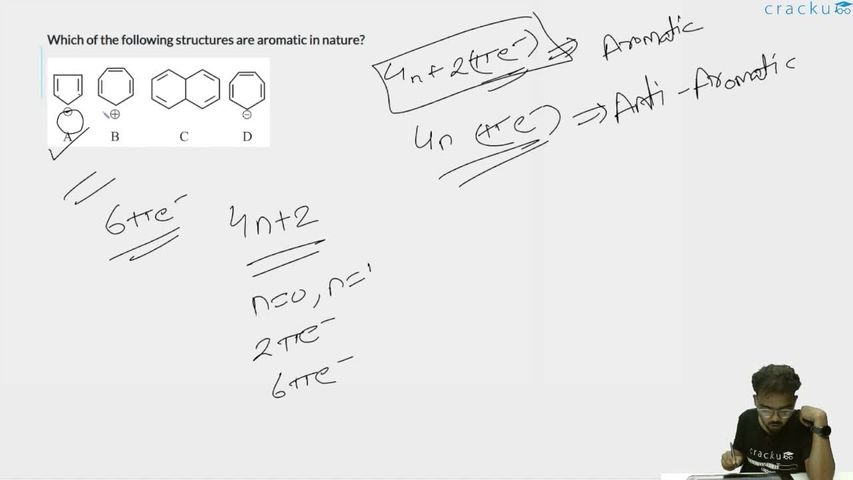
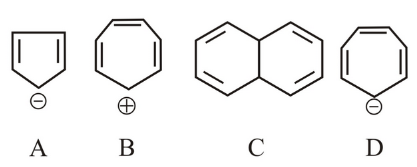
Which of the following structures are aromatic in nature?
image

For a compound to be aromatic, it must fulfill four criteria:

  1. Cyclic: The structure must be a closed ring.
    $$\text{}$$
  2. Planar: All atoms in the ring must be $$sp^2$$ hybridized so the p-orbitals can align.
    $$\text{}$$
  3. Fully Conjugated: There must be a continuous system of alternating double bonds, positive charges, negative charges, or lone pairs around the entire ring.
    $$\text{}$$
  4. Hückel's Electron Count: The conjugated loop must contain $$(4n + 2)\,\pi$$ electrons (where $$n = 0, 1, 2, 3...$$, giving allowed counts of $$2, 6, 10, 14...\,\pi$$ electrons)
  • A (Cyclopentadienyl Anion): Cyclic, planar, fully conjugated. It has 2 double bonds ($$4\pi$$ $$e^-$$) + 1 negative charge lone pair ($$2\pi$$ $$e^-$$) = $$6\pi$$ electrons ($$n=1$$). Aromatic.
    $$\text{}$$
  • B (Tropylium Cation): Cyclic, planar, fully conjugated. It has 3 double bonds ($$6\pi$$ $$e^-$$) + 1 empty p-orbital from the positive charge = $$6\pi$$ electrons ($$n=1$$). Aromatic.
    $$\text{}$$
  • C (Naphthalene): Cyclic, planar, fully conjugated bicyclic system. It has 5 double bonds = $$10\pi$$ electrons ($$n=2$$). Aromatic.
    $$\text{}$$
  • D (Cycloheptatrienyl Anion): It contains 3 double bonds ($$6\pi$$ $$e^-$$) + 1 negative charge lone pair ($$2\pi$$ $$e^-$$) = $$8\pi$$ electrons. This follows the $$4n$$ rule ($$n=2$$), making it Anti-aromatic (non-aromatic in reality as it tubs to lose planarity). Not Aromatic.

Get AI Help

Video Solution

video

Create a FREE account and get:

  • Free JEE Mains Previous Papers PDF
  • Take JEE Mains paper tests
Ask AI