
Join Our JEE Preparation Group
Prep with like-minded aspirants; Get access to free daily tests and study material.
Sign in
Please select an account to continue using cracku.in
↓ →
Join Our JEE Preparation Group
Prep with like-minded aspirants; Get access to free daily tests and study material.
For 1 mol of gas, the plot of pV vs p is shown below. p is the pressure and V is the volume of the gas.
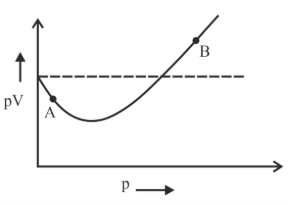
What is the value of compressibility factor at point A?
For one mole of a real gas, the Van der Waals equation is
$$\left(P+\frac{a}{V^2}\right)(V-b)=RT.$$
Expanding the equation,
$$PV-Pb+\frac{a}{V}-\frac{ab}{V^2}=RT.$$
Dividing throughout by (RT),
$$\frac{PV}{RT}-\frac{Pb}{RT}+\frac{a}{RTV}-\frac{ab}{RTV^2}=1.$$
Since the compressibility factor is defined as
$$Z=\frac{PV}{RT},$$
we obtain
$$Z-\frac{Pb}{RT}+\frac{a}{RTV}-\frac{ab}{RTV^2}=1.$$
At low pressures, the molar volume (V) is very large, so terms containing (\frac{1}{V^2}) can be neglected. Therefore,
$$Z\approx 1-\frac{a}{RTV}.$$
Point A corresponds to the low-pressure region where intermolecular attractive forces dominate, causing the gas to be more compressible than an ideal gas ((Z<1)). The deviation from ideal behaviour is represented by the attractive term (-\frac{a}{RTV}).
Hence, the compressibility factor at point A is
$$\boxed{Z=1-\frac{a}{RTV}}.$$
Therefore, the correct answer is
$$\boxed{1-\frac{a}{RTV}}.$$
Was this solution helpful?
Create a FREE account and get:
_1.webp)

Educational materials for JEE preparation

Ask our AI anything

AI can make mistakes. Please verify important information.
AI can make mistakes. Please verify important information.
