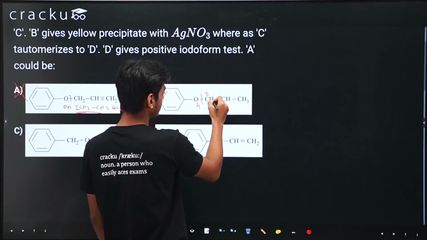
1. Finding Compound 'B' (Yellow Precipitate with AgNO3)
When an ether is cleaved with concentrated hydroiodic acid (HI), it breaks into an alcohol/phenol and an alkyl iodide.
- The problem states that compound 'B' gives a yellow precipitate when treated with silver nitrate (AgNO3).
- This tells us that 'B' is an iodide compound that can easily form a stable carbocation to release the iodide ion (I-), which reacts with silver ions to form silver iodide (AgI, a yellow ppt).
- Benzyl iodide (C6H5-CH2-I) forms a highly stable benzyl carbocation via resonance, making it extremely reactive toward AgNO3. Therefore, 'B' is Benzyl iodide.
2. Finding Compound 'C' and 'D' (Tautomerization and Iodoform Test)
- The other product formed during the cleavage is compound 'C'.
- The question states that 'C' tautomerizes to 'D', and 'D' gives a positive iodoform test.
- For a compound to give a positive iodoform test, it must contain a methyl ketone group (CH3-C=O) or an alcohol that can be oxidized to a methyl ketone.
- If 'C' tautomerizes to a methyl ketone, 'C' must be an enol (specifically, vinyl alcohol: CH2=CH-OH).
- Vinyl alcohol ('C') tautomerizes to Acetaldehyde ('D', CH3-CHO), which contains the necessary methyl group adjacent to the carbonyl carbon to give a positive iodoform test.
The Reaction Protocol for Option C
Let's test Option C: C6H5-CH2-O-CH=CH2 (Benzyl vinyl ether)
Step A: Cleavage with conc. HI
The oxygen atom gets protonated, and the iodide ion attacks the benzyl group because the benzyl carbocation is highly stable (or passes through a favorable SN1/SN2 pathway).
- C6H5-CH2-O-CH=CH2 + HI ---> C6H5-CH2-I (Compound B) + CH2=CH-OH (Compound C)
Step B: Testing Compound B
- C6H5-CH2-I + AgNO3 ---> AgI (Yellow Precipitate) + C6H5-CH2-ONO2
Step C: Tautomerization of Compound C
- CH2=CH-OH (Enol form 'C') ---> CH3-CHO (Keto/Aldehyde form 'D')
Step D: Iodoform Test on Compound D
- CH3-CHO + 3 I2 + 4 NaOH ---> CHI3 (Iodoform yellow ppt) + HCOONa + 3 NaI + 3 H2O
This perfectly satisfies every single condition in the question.
Why the Other Options are Incorrect
- Option A (C6H5-O-CH2-CH=CH2): Cleavage with HI would break the aliphatic bond because the phenyl-oxygen bond (C6H5-O) has partial double-bond character due to resonance and cannot be easily broken. This would yield Phenol (C6H5-OH) and Allyl Iodide (CH2=CH-CH2-I). Neither of these products can tautomerize to give a positive iodoform test.
- Option B (C6H5-O-CH=CH-CH3): Cleavage with HI yields Phenol (C6H5-OH) and Propen-1-ol (CH3-CH=CH-OH). While Propen-1-ol tautomerizes to Propanal (CH3-CH2-CHO), Propanal does not have a CH3-C=O group and will fail the iodoform test.
- Option D (CH3-C6H4-O-CH=CH2): Cleavage with HI yields p-Cresol (CH3-C6H4-OH) and Vinyl alcohol (CH2=CH-OH). Vinyl alcohol would form Acetaldehyde and pass the iodoform test, but p-Cresol will not react with AgNO3 to give a yellow precipitate because the iodine would have to attach directly to the benzene ring (aryl iodide), which does not readily undergo substitution to release iodide ions.