
Join Our JEE Preparation Group
Prep with like-minded aspirants; Get access to free daily tests and study material.
Sign in
Please select an account to continue using cracku.in
↓ →
Join Our JEE Preparation Group
Prep with like-minded aspirants; Get access to free daily tests and study material.
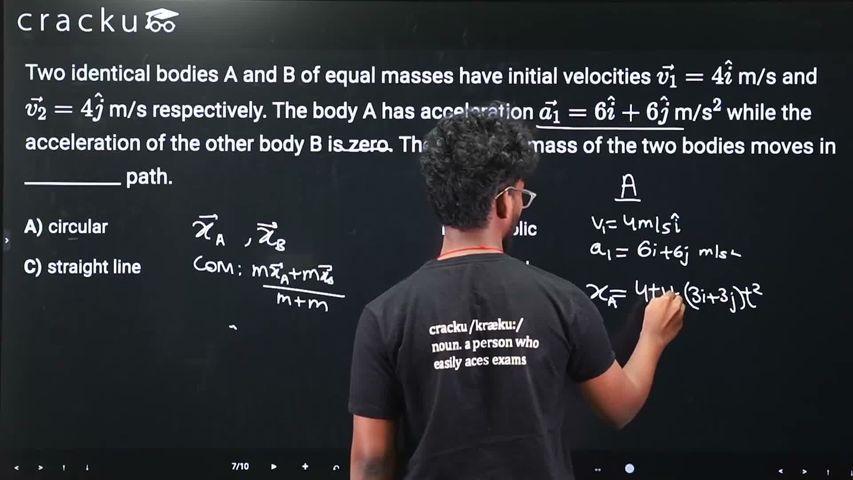
Two identical bodies A and B of equal masses have initial velocities $$\vec{v_1} = 4\hat{i}$$ m/s and $$\vec{v_2} = 4\hat{j}$$ m/s respectively. The body A has acceleration $$\vec{a_1} = 6\hat{i} + 6\hat{j}$$ m/s$$^2$$ while the acceleration of the other body B is zero. The centre of mass of the two bodies moves in __________ path.
$$\vec{v}_{\text{cm}} = \frac{m\vec{v}_1 + m\vec{v}_2}{m + m} = \frac{\vec{v}_1 + \vec{v}_2}{2}$$
$$\vec{v}_{\text{cm}} = \frac{4\hat{i} + 4\hat{j}}{2} = 2\hat{i} + 2\hat{j}\text{ m/s}$$
$$\vec{a}_{\text{cm}} = \frac{m\vec{a}_1 + m\vec{a}_2}{m + m} = \frac{\vec{a}_1 + \vec{a}_2}{2}$$
$$\vec{a}_{\text{cm}} = \frac{6\hat{i} + 6\hat{j} + 0}{2} = 3\hat{i} + 3\hat{j}\text{ m/s}^2$$
Direction of $$\vec{v}_{\text{cm}} = 2(\hat{i} + \hat{j})$$
Direction of $$\vec{a}_{\text{cm}} = 3(\hat{i} + \hat{j})$$
Since $$\vec{a}_{\text{cm}}$$ is a scalar multiple of $$\vec{v}_{\text{cm}}$$ ($$\vec{a}_{\text{cm}} = \frac{3}{2}\vec{v}_{\text{cm}}$$), the acceleration vector is perfectly parallel to the initial velocity vector.
When the acceleration of a particle or a system's center of mass is collinear with its initial velocity, the direction of motion never turns, meaning it moves along a straight line.
Was this solution helpful?
Click on the Email ☝️ to Watch the Video Solution
Create a FREE account and get:
_1.webp)

Educational materials for JEE preparation

Ask our AI anything

AI can make mistakes. Please verify important information.
AI can make mistakes. Please verify important information.
