
Join Our JEE Preparation Group
Prep with like-minded aspirants; Get access to free daily tests and study material.
Sign in
Please select an account to continue using cracku.in
↓ →
Join Our JEE Preparation Group
Prep with like-minded aspirants; Get access to free daily tests and study material.
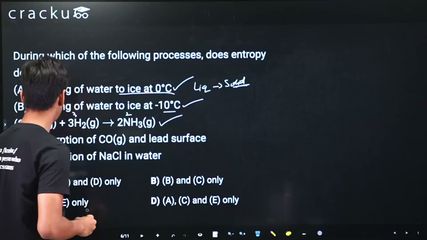
During which of the following processes, does entropy decrease?
(A) Freezing of water to ice at 0°C
(B) Freezing of water to ice at -10°C
(C) N$$_2$$(g) + 3H$$_2$$(g) $$\to$$ 2NH$$_3$$(g)
(D) Adsorption of CO(g) and lead surface
(E) Dissolution of NaCl in water
We need to identify processes where entropy decreases.
(A) Freezing of water to ice at 0°C converts a liquid to a more ordered solid, so entropy decreases.
(B) Freezing of water to ice at $$-10°\text{C}$$ also converts liquid to solid, which decreases entropy. Although this is not at the equilibrium freezing point, the phase change itself still involves a decrease in entropy of the system.
(C) $$\text{N}_2(g) + 3\text{H}_2(g) \to 2\text{NH}_3(g)$$: four moles of gas become two moles, reducing the disorder, so entropy decreases.
(D) Adsorption of $$\text{CO}(g)$$ on a lead surface restricts the gas molecules to a surface, decreasing their freedom of motion, so entropy decreases.
(E) Dissolution of NaCl in water involves breaking the crystal lattice and dispersing ions into solution, which increases the entropy.
Processes (A), (B), (C), and (D) all show a decrease in entropy, making the correct answer (A), (B), (C) and (D) only.
Was this solution helpful?
Click on the Email ☝️ to Watch the Video Solution
Create a FREE account and get:
_1.webp)

Educational materials for JEE preparation

Ask our AI anything

AI can make mistakes. Please verify important information.
AI can make mistakes. Please verify important information.


