
Join Our JEE Preparation Group
Prep with like-minded aspirants; Get access to free daily tests and study material.
Sign in
Please select an account to continue using cracku.in
↓ →
Join Our JEE Preparation Group
Prep with like-minded aspirants; Get access to free daily tests and study material.
Which transition in the hydrogen spectrum would have the same wavelength as the Balmer type transition from n = 4 to n = 2 of He$$^+$$ spectrum
Using the Rydberg formula,
$$\frac{1}{\lambda}=RZ^2\left(\frac{1}{n_1^2}-\frac{1}{n_2^2}\right).$$
For the (He^+) transition with (Z=2), (n_2=4), and (n_1=2),
$$\frac{1}{\lambda}=R(2)^2\left(\frac{1}{2^2}-\frac{1}{4^2}\right).$$
Simplifying,
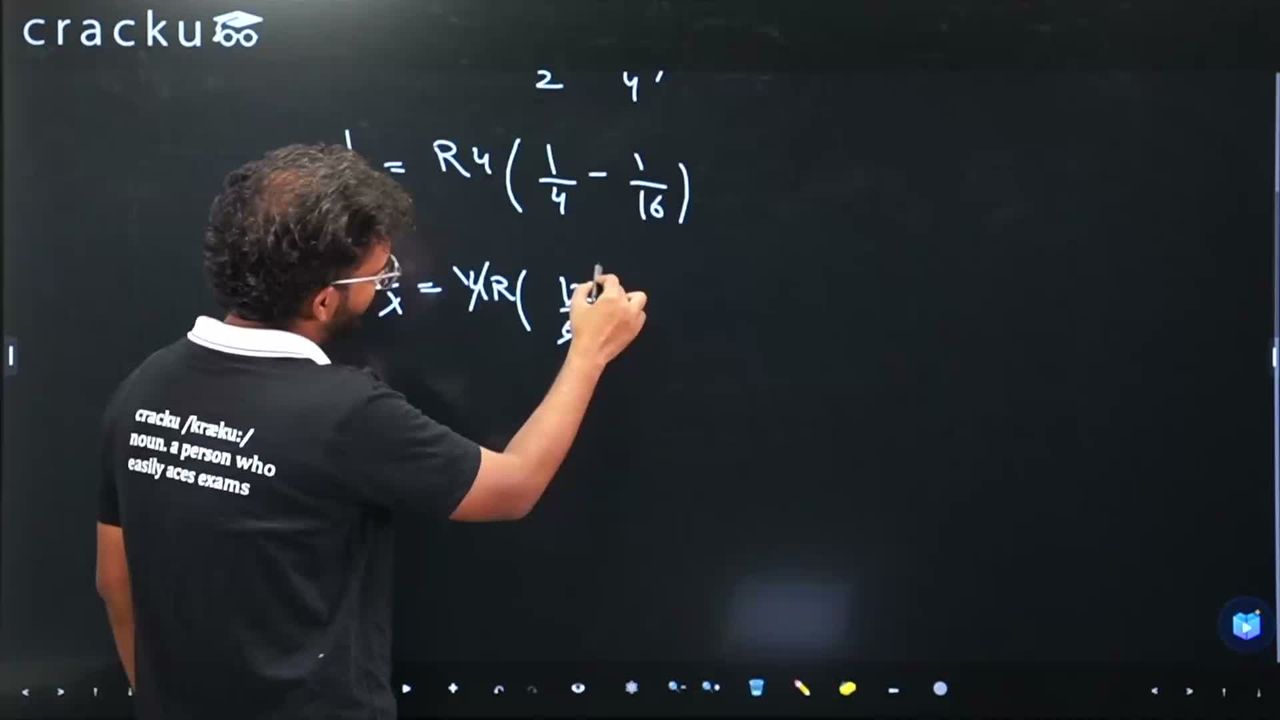
$$\frac{1}{\lambda}=4R\left(\frac{1}{4}-\frac{1}{16}\right)=4R\left(\frac{3}{16}\right)=\frac{3R}{4}.$$
For hydrogen ((Z=1)),
$$\frac{1}{\lambda}=R\left(\frac{1}{n_1^2}-\frac{1}{n_2^2}\right).$$
Equating the two expressions,
$$\frac{3R}{4}=R\left(\frac{1}{n_1^2}-\frac{1}{n_2^2}\right),$$
$$\frac{3}{4}=\frac{1}{n_1^2}-\frac{1}{n_2^2}.$$
Taking (n_1=1) and (n_2=2),
$$\frac{1}{1^2}-\frac{1}{2^2}=1-\frac{1}{4}=\frac{3}{4},$$
which satisfies the required condition.
Hence, the corresponding transition in the hydrogen spectrum is
$$\boxed{n=2\rightarrow n=1}.$$
Was this solution helpful?
Click on the Email ☝️ to Watch the Video Solution
Create a FREE account and get:
_1.webp)

Educational materials for JEE preparation

Ask our AI anything

AI can make mistakes. Please verify important information.
AI can make mistakes. Please verify important information.
