
Join Our JEE Preparation Group
Prep with like-minded aspirants; Get access to free daily tests and study material.
Sign in
Please select an account to continue using cracku.in
↓ →
Join Our JEE Preparation Group
Prep with like-minded aspirants; Get access to free daily tests and study material.
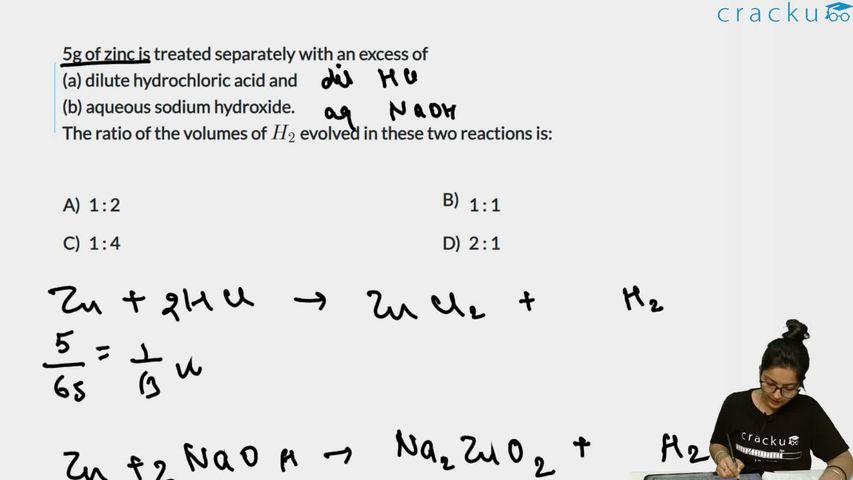
5g of zinc is treated separately with an excess of
(a) dilute hydrochloric acid and
(b) aqueous sodium hydroxide.
The ratio of the volumes of $$H_2$$ evolved in these two reactions is:
First we note the atomic (molar) mass of zinc:
$$M_{\text{Zn}} = 65 \ \text{g mol}^{-1}$$
The mass of zinc given is
$$m_{\text{Zn}} = 5 \ \text{g}$$
Hence the number of moles of zinc present is obtained from the relation
$$n = \dfrac{m}{M}$$
Substituting the values, we get
$$n_{\text{Zn}} = \dfrac{5 \ \text{g}}{65 \ \text{g mol}^{-1}} = \dfrac{5}{65} \ \text{mol} = \dfrac{1}{13} \ \text{mol}$$
Now we consider the two separate reactions.
Reaction (a): Zinc with dilute hydrochloric acid
The balanced chemical equation is
$$\text{Zn} + 2\,\text{HCl} \longrightarrow \text{ZnCl}_2 + \text{H}_2$$
From the equation we see that
1 mol Zn → 1 mol H2
Therefore, the moles of hydrogen evolved in this case will be
$$n_{\text{H}_2,\; \text{from HCl}} = n_{\text{Zn}} = \dfrac{1}{13} \ \text{mol}$$
Reaction (b): Zinc with aqueous sodium hydroxide
The balanced chemical equation is
$$\text{Zn} + 2\,\text{NaOH} \longrightarrow \text{Na}_2\text{ZnO}_2 + \text{H}_2$$
(The product Na2ZnO2 is called sodium zincate.)
Again, we observe from the equation that
1 mol Zn → 1 mol H2
Thus the moles of hydrogen evolved here are also
$$n_{\text{H}_2,\; \text{from NaOH}} = n_{\text{Zn}} = \dfrac{1}{13} \ \text{mol}$$
Since both reactions produce the same number of moles of hydrogen gas, and equal moles of any gas occupy equal volumes under identical conditions (Avogadro’s law), the volumes of hydrogen obtained from the two experiments are equal.
Therefore,
$$V_{\text{H}_2\;(\text{from HCl})} : V_{\text{H}_2\;(\text{from NaOH})} = 1 : 1$$
Hence, the correct answer is Option B.
Was this solution helpful?
Click on the Email ☝️ to Watch the Video Solution
Create a FREE account and get:
_1.webp)

Educational materials for JEE preparation

Ask our AI anything

AI can make mistakes. Please verify important information.
AI can make mistakes. Please verify important information.
