
Join Our JEE Preparation Group
Prep with like-minded aspirants; Get access to free daily tests and study material.
Sign in
Please select an account to continue using cracku.in
↓ →
Join Our JEE Preparation Group
Prep with like-minded aspirants; Get access to free daily tests and study material.
Among the statements (a) - (d), the correct ones are:
(a) Lithium has the highest hydration enthalpy among the alkali metals.
(b) Lithium chloride is insoluble in pyridine.
(c) Lithium cannot form ethynide upon its reaction with ethyne.
(d) Both lithium and magnesium react slowly with $$H_2O$$.
We examine every statement one by one and compare it with the standard properties of lithium, the other alkali metals and magnesium.
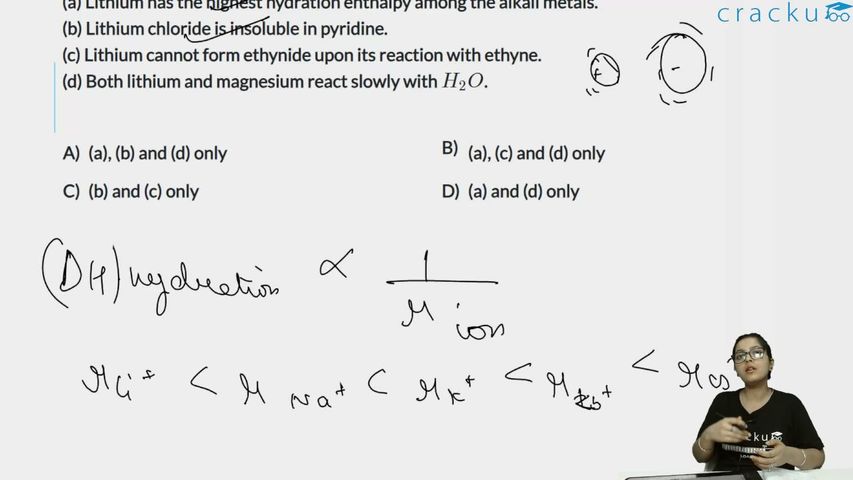
For statement (a) we recall the relation between hydration enthalpy and ionic radius. Hydration enthalpy $$\Delta H_{\text{hyd}}$$ is inversely proportional to the ionic radius, i.e. $$\Delta H_{\text{hyd}}\propto\dfrac{1}{r_{\text{ion}}}.$$ Among the alkali-metal ions $$\text{Li}^+,\; \text{Na}^+,\; \text{K}^+,\; \text{Rb}^+,\; \text{Cs}^+$$ the radius order is $$r_{\text{Li}^+}<r_{\text{Na}^+}<r_{\text{K}^+}<r_{\text{Rb}^+}<r_{\text{Cs}^+}.$$ Because lithium ion is the smallest, its hydration enthalpy is the highest. So statement (a) is correct.
For statement (b) we use Fajans’ rule: the smaller the cation and the larger the anion, the greater the covalent character of the salt. $$\text{LiCl}$$ therefore possesses considerable covalent character and, like many covalent chlorides, it dissolves in organic solvents such as ethanol, acetone and pyridine. Hence lithium chloride is actually soluble in pyridine, not insoluble. Therefore statement (b) is false.
For statement (c) we look at the direct reaction of metals with ethyne (acetylene). For sodium and the heavier alkali metals the equation is
$$2M + C_2H_2 \longrightarrow M_2C_2 + H_2,$$
where $$M = \text{Na},\,\text{K},\,\text{Rb},\,\text{Cs}.$$ Because of the exceptionally high lattice energy of the small $$\text{Li}^+$$ ion, lithium metal itself does not follow this route; it does not give lithium ethynide directly with ethyne. (Laboratory preparations of lithium acetylide are done via lithium amide or other routes, not by the direct metal-ethyne reaction.) Thus lithium cannot form ethynide upon its direct reaction with ethyne, so statement (c) is correct.
For statement (d) we compare the speed of reaction with water.
• Lithium reacts with water, but very sluggishly compared with the other alkali metals because of its higher ionisation enthalpy and the formation of a protective layer of $$\text{LiOH}$$ on the surface: $$2\text{Li} + 2H_2O \rightarrow 2\text{LiOH} + H_2.$$
• Magnesium also reacts only slowly with cold water; it forms a thin film of $$\text{Mg(OH)}_2$$ that limits further attack: $$\text{Mg} + 2H_2O \rightarrow \text{Mg(OH)}_2 + H_2.$$ In hot water or steam the reaction is faster, but with cold water both metals are indeed slow. Hence statement (d) is correct.
We now collect the true statements: (a), (c) and (d). This set corresponds to Option B.
Hence, the correct answer is Option B.
Was this solution helpful?
Click on the Email ☝️ to Watch the Video Solution
Create a FREE account and get:
_1.webp)

Educational materials for JEE preparation

Ask our AI anything

AI can make mistakes. Please verify important information.
AI can make mistakes. Please verify important information.
