
Join Our JEE Preparation Group
Prep with like-minded aspirants; Get access to free daily tests and study material.
Sign in
Please select an account to continue using cracku.in
↓ →
Join Our JEE Preparation Group
Prep with like-minded aspirants; Get access to free daily tests and study material.
The solubility product of $$Cr(OH)_3$$ at 298K is $$6.0 \times 10^{-31}$$. The concentration of hydroxide ions in a saturated solution of $$Cr(OH)_3$$ will be:
When solid $$Cr(OH)_3$$ is added to water, it dissociates according to
$$Cr(OH)_3(s)\; \rightleftharpoons\; Cr^{3+}(aq) \;+\; 3\,OH^-(aq)$$
For every one mole that dissolves, the solution receives one mole of $$Cr^{3+}$$ and three moles of $$OH^-$$. If the molar solubility (the number of moles of solid that actually dissolve per litre) is denoted by $$s$$, then
$$[Cr^{3+}] = s,\qquad [OH^-] = 3s$$
The solubility-product constant $$K_{sp}$$ is defined, for a salt $$A_mB_n$$ that dissociates as $$A_mB_n \to m\,A^{n+}+n\,B^{m-}$$, by the formula
$$K_{sp} = [A^{n+}]^{\,m}\,[B^{m-}]^{\,n}$$
Applying this definition to the present equilibrium gives
$$K_{sp} = [Cr^{3+}]\,[OH^-]^{\,3}$$
Substituting the concentrations expressed through $$s$$, we obtain
$$K_{sp} = (s)\,(3s)^{3}$$
$$\Rightarrow\; K_{sp} = s\;\times\;27s^{3}$$
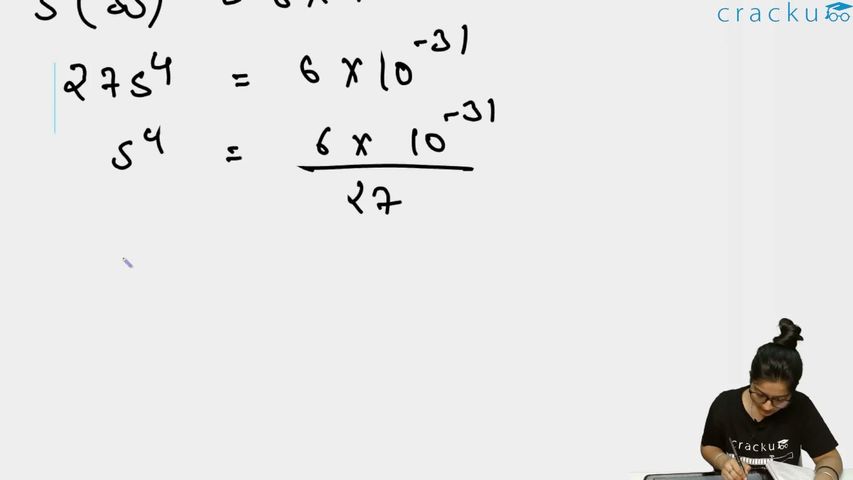
$$\Rightarrow\; K_{sp} = 27s^{4}$$
Now we solve for $$s$$. First isolate $$s^{4}$$:
$$s^{4} = \dfrac{K_{sp}}{27}$$
The numerical value of the solubility product is given as $$K_{sp} = 6.0 \times 10^{-31}$$, so
$$s^{4} = \dfrac{6.0 \times 10^{-31}}{27}$$
Because $$27 = 3 \times 9$$ and $$6.0/27 = 0.222\ldots$$, the fraction simplifies to
$$s^{4} = 2.22 \times 10^{-32}$$
Taking the fourth root gives the solubility:
$$s = \left(2.22 \times 10^{-32}\right)^{\tfrac{1}{4}}$$
However, the question asks for the hydroxide-ion concentration, not for $$s$$. Recall that
$$[OH^-] = 3s$$
Raise both sides of this last relation to the fourth power:
$$[OH^-]^{4} = (3s)^{4} = 3^{4}\,s^{4} = 81\,s^{4}$$
Substituting the expression just found for $$s^{4}$$ gives
$$[OH^-]^{4} = 81\,(2.22 \times 10^{-32}) = 18 \times 10^{-31}$$
Finally, take the fourth root to obtain the desired concentration:
$$[OH^-] = \left(18 \times 10^{-31}\right)^{\tfrac{1}{4}}$$
This matches exactly with Option B in the list provided.
Hence, the correct answer is Option 2.
Was this solution helpful?
Click on the Email ☝️ to Watch the Video Solution
Create a FREE account and get:
_1.webp)

Educational materials for JEE preparation

Ask our AI anything

AI can make mistakes. Please verify important information.
AI can make mistakes. Please verify important information.
