
Join Our JEE Preparation Group
Prep with like-minded aspirants; Get access to free daily tests and study material.
Sign in
Please select an account to continue using cracku.in
↓ →
Join Our JEE Preparation Group
Prep with like-minded aspirants; Get access to free daily tests and study material.
Student A and student B used two screw gauges of equal pitch and 100 equal circular divisions to measure the radius of a given wire. The actual value of the radius of the wire is 0.322 cm. The absolute value of the difference between the final circular scale readings observed by the students A and B is ___.
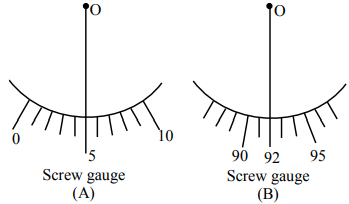
Given pitch = 0.1 cm.
Correct Answer: 13
We need to determine the absolute value of the difference between the final circular scale readings observed by student A and student B when measuring the radius of a wire.
From the problem page, both screw gauges have the same pitch and total number of circular divisions:
The least count ($$\text{LC}$$) is calculated as:
$$\text{LC} = \frac{\text{Pitch}}{\text{Number of circular divisions}} = \frac{0.1\text{ cm}}{100} = 0.001\text{ cm}$$
Looking at the provided reference diagrams, we can determine the initial zero error for each student's instrument based on where the zero mark lies relative to the reference line:
$$\text{Zero Error}_A = +5 \times \text{LC} = +5 \times 0.001\text{ cm} = +0.005\text{ cm}$$
$$\text{Zero Error}_B = -(100 - 92) \times \text{LC} = -8 \times 0.001\text{ cm} = -0.008\text{ cm}$$
The true radius value is given as $$\text{True Reading} = 0.322\text{ cm}$$. The general formula for a measurement is:
$$\text{True Reading} = \text{Observed Reading} - \text{Zero Error}$$
$$\text{True Reading} = (\text{Main Scale Reading} + n \times \text{LC}) - \text{Zero Error}$$
Where $$n$$ represents the final circular scale reading. Let's express this for both students:
$$0.322 = \text{MSR}_A + (n_A \times 0.001) - 0.005$$
$$n_A \times 0.001 = 0.327 - \text{MSR}_A$$
$$0.322 = \text{MSR}_B + (n_B \times 0.001) - (-0.008)$$
$$n_B \times 0.001 = 0.314 - \text{MSR}_B$$
Since both gauges have a pitch of $$0.1\text{ cm}$$, the pitch/main scale reading ($$\text{MSR}$$) must be identical for measuring the same object ($$\text{MSR}_A = \text{MSR}_B = 0.3\text{ cm}$$). Let's solve for the exact circular scale divisions ($n_A$$ and $$n_B$$):
$$n_A \times 0.001 = 0.327 - 0.3 = 0.027 \implies n_A = 27$$
$$n_B \times 0.001 = 0.314 - 0.3 = 0.014 \implies n_B = 14$$
Finally, find the absolute difference between the two circular scale readings ($$n_A$$ and $$n_B$$):
$$\text{Difference} = |n_A - n_B| = |27 - 14| = 13$$
The absolute value of the difference between the final circular scale readings observed by the students is 13.
Was this solution helpful?
Create a FREE account and get:
_1.webp)

Educational materials for JEE preparation

Ask our AI anything

AI can make mistakes. Please verify important information.
AI can make mistakes. Please verify important information.
